Thiru Vedikudi Temple: Lord Vedapureeswarar..
The place Thiru Vedikudi is about 7kms North to Tanjore on the banks of River Vettaru. This temple is one of the Devara sthalam. This temple is one of the Ezhoor temples visited by Lord Iyarappar of Thiruvaiaru, in the Tamil month of Chiittarai (April/ May).
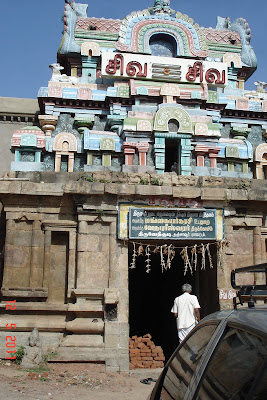
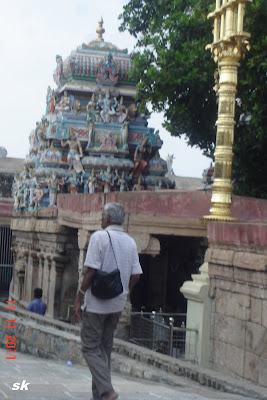
The temple has Raja gopuram of three storey, and single prakaram.
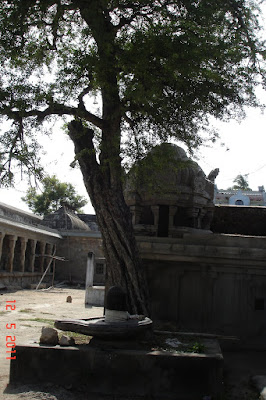
Sthala Vruksham is Vilvam and Teertham is Veida teertham.
Main Deity is Swayambu Lingam known as Arulmigu Vedapureeswarar and his consort known as Mangayarkarasi Amman. Sun rays falls on 13,14 and 15 of tamil month Panguni (March/ April).
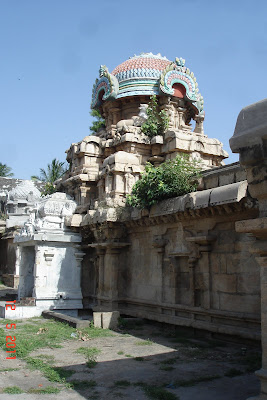
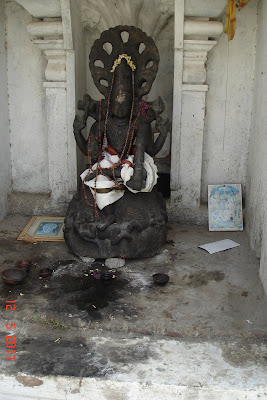
As we go round the prakaram deities seen in the temple are Sevi Saaitha Vinayakar, 108 Siva Lingam, Dakshina Moorthy, Ardhanareeswarar, Durgai, Murugan, Mahalakshmi, Natarajar, Lakshmi Narayanar and Hanuman is seen at the feet of Him, Saptha Sthana Lingams.
Lord Brahma worshiped Lord Siva here hence the name Vedikudi for the place. Vedas worshiped Lord Siva here and were blessed. Vinayakar enjoys listening to chanting of Vedas; hence he is known as Sevi Saaitha Vinayakar / Veda Vinayakar. The temple Vimanama construction is of stones. Nandi is seen to four sides of Temple Vimanam, represting four Vedas. Ardhanareeswarar form here is unusual in this temple. Here Ambal is seen to the right side of Ardhanareeswarar who is seen as Koshta Deivam at the back of main sanctum.
Sthala purana says once Vedas were taken away from Brahma by the Asuras and it was hidden under the ocean. The Vedas were brought back by Lord Narayanar. Vedas worshiped Lord Siva to get rid of their Dosha of being with Asura. The Vedas were blessed by Lord Siva. On request of Vedas Lord Siva stayed back in this place as Vedapureeswarar.
Thiru Navukkarasar and Thiru Gyana Sambandhar sang Hymns on Lord Siva here. Arunagirinadhar sang Thirupugazh on Lord Murugan of this temple.
Stone inscriptions of Rajakesri Varman and Koparakesari Varman period are seen in the temple they say the Lord is known as Thiru Vedikudi Mahadevar and Para kesari Chaturvedi mangala Mahadevar.
Mel Kadambur / Kadambar: Arulmigu Amirtha kadeswarar temple. Kattumannar koil taluk, Cuddlore District.
Mel Kadambur / Kadambar:
Arulmigu Amirtha kadeswarar temple.
This temple is one of the Nadu Naadu Devara Sthalams. The
temple is about 5 kms distance to SW from Kattumannaar Koil on the bank of
River Kollidam.

The main Raja Gopuram is of three tiers.
Main Deity is Swayambu Lingam known as Arulmigu Amirtha
kadeswarar facing east and his consort Vidhyujyothi Nayaki Amman in different
sanctum. Sun rays falls on Siva Lingam on 3, 4, and 5, of Panguni Month (March
and April). Moon rays falls on Siva Lingam in the Month of Iyppasi full- moon
day.
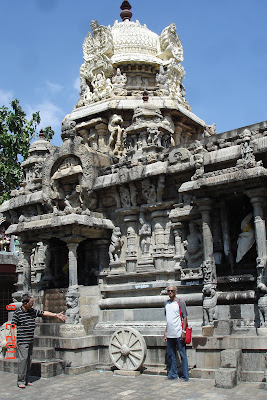
The temple is constructed with stones. It is like a Chariot.
We can see horses also to the chariot in the front sides.
Vinayakar in this temple is known as Aravara Vinayakar in
separate sanctum. He looks serious leaning his head slightly to left.
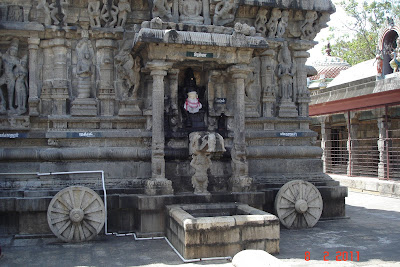
Athithi, mother of Devas worshipped Lord Siva in this place
which was not liked by Devendran. So Indra wanted to take away the Lord
Amirthakadeswar to his place. He turned the temple as Chariot and pulled it.
Vinayakar wanted to teach him a lesson by pressing the Chariot. So the left wheel
is struck to earth.
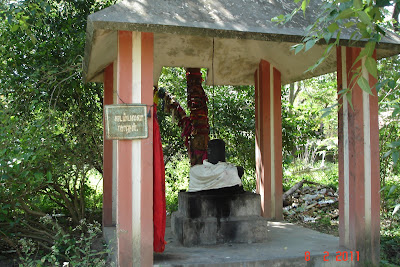
Sthala Vruksham is Kadamba Vruksham
Teertham is Sakthi teertham
As we go around the prakaram, we see Kanni Vinayakar,
Murugan, Ardhanareeswarar, Uma Maheswarar, Agyasthyar, Nalwar, Meenakshi,
Lakshmi, Lingothbavar, Brahma, Chandekeswarar, Durgai, Navagraham and Chandikeswarar.
To the outer wall of the main sanctum we see beautiful
sculptures.
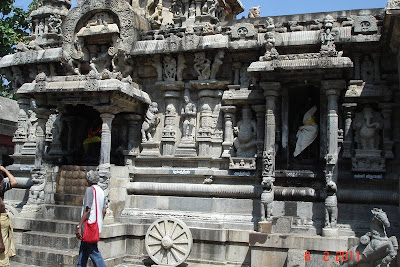
Here we see Kanni Vinayakar, Agasthyar, Devandran and
Ardhanareeswarar.

Durga Matha.

Alingana moorthy.

Gangadharar.
Lord Brahma, Parvatha Rajan and Chitraguptan to left of
Brahma. Pathanjali muni and Gangadharar are seen to right of Lord Brahma.

Lord Dakshina Moorthy.
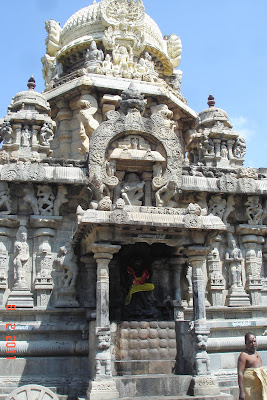
Here on top of Dakshina Moorthy we see a sculpture of
Dakshina Moorthy with Veena in his hand and above that we see another Sculpture
of Dakshina moorthy with flute in his hand.

Ardhanareeswarar.

Kala Bairavar.

Saneeswarar
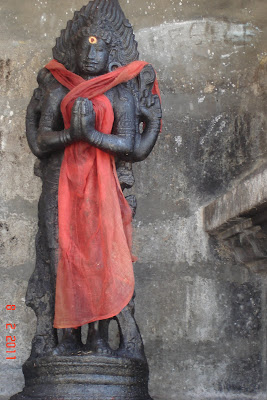
Veerabadrar.
Lord Murugan received his Bow to destroy Sooran, by
worshipping Lord Siva in this temple. Sani Baghwan in the temple is seen with
Eagle as his vahana. Purana says King Dasaradha gave crow to Sani Bhagawan who
replaced it for eagle. The Moorthy is older to Ramayana period.
When Devas churned the Ocean, pot of nectar was given to Lord
Indra. They tried to consume the Amirtam without worshipping Lord. Vinayakar
angrily took away the nectar pot to teach them a lesson. When Vinayaka was
passing through this place a drop of nectar fell down and this formed as Siva
Lingam. Hence the Lord is known as Amirtakadeswarar.
The place was full of Kadamba Vruksham; hence the place is
known also known as Kadambar
Sthala Purana says Devas and Indra, realized their mistake
and worshipped Lord Siva in this place and received the nectar from Him. Lord
Siva stayed back in this place as Amirthakadeswarar. When Indra was not able to
lift the chariot temple from this place he worshipped Lord Vinayaka to help
him. Lord Vinayaka agreed and asked Indra to install one Crore Lingam and he
accepted the challenge. Due to his pride he failed in his attempt. Indra
worshipped Lord Siva who asked him to make a Siva Lingam chanting his name
thousand times. Indra made Rudrakoteeswara and worshipped him.
Lord Amirthakadeswarar appeared before him and he said he
wished to stay back in this place. It is believed that Indra worships Lord Siva
of this temple daily.

Importance of the temple is there is Urchava idol of Rishba
Thandava Moorthy with 10 hands. Special Pooja is performed on pradosha days of
New, Full Moon. Here we see Goddess Parvathy, Lord Vishnu, Lord Vinayaka,
Bairava, and Veerabadrar, Maharishis like Narada, Brungi, Mruganda, Nandi Devar,
Gandrava and Boodha Ganas watching the Thandavam.
Goddess Vidhyujyothi Nayaki Amman is considered to posses
the Sakthi of Goddess Saraswathy, Goddess Maha Lakshmi and Goddess Durga matha.
In the morning she graces as Goddess Saraswathy with Veena, in the midday with Elephant
as Goddess Maha Lakshmi, and in the evening as Goddess Durga Matha with Tridend.
Hence the name Vidyajyothi Nayaki
Navagraha worship Lord Siva here. So Lord Siva is dreesed
with cloth of respective colors. The temple is regarded as Navagraha Parihara
Sthalam
Thiru Navukkarasar, Thiru Gyana Sambandhar, Mannikkavachakar
and Sundarar have worshiped and sang Hymns praising the Lord Siva. Arunagiri
Nadhar sang Thirupugazh on Lord Murugan.
Yaganti: Sri
Uma Maheswara
Swamy Temple.
Yaganti is
located in Kurnool District of AP.
The place is about 300 kms from Hyderabad.
Yaganti is well connected by bus
from all the places. We visited Alampur,
and from there we visited Yaganti, via
Bethamcharla, and Banagapalli.
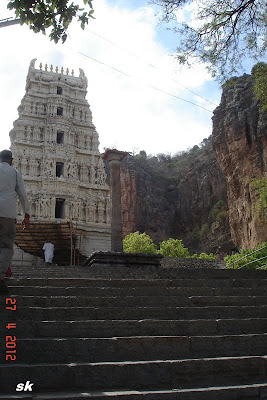
Sri Uma Maheswara
Swamy temple is one of the holy temples in Kurnool. The temple is surrounded
by mountains. There are several natural caves which add to scenic beauty to the
place. People visit the place in large number during Maha Sivarathri day. The temple was constructed and completed by first Vijayanagara Sangama Kings Harihara
Bukkarayalu in 15th Century.
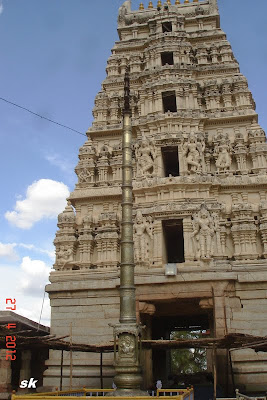
There is a five tier Raja Gopuram for the temple with
Dwajasthambam erected.
Main Deity is Lord
Siva in Ardhanareeswara form known as Uma Maheswara Swamy.
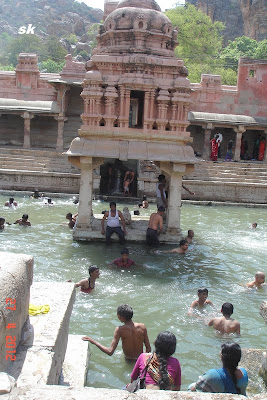
There is a small pond in front of the temple.

Interesting fact
about this pushkarani is there is water all round the year. Here water flows
into the pushkarani from bottom of the hill through the mouth of Nandi. We do not see any water flowing
from the hill. No one knows how the water reaches the pushkarani in all season.
Holy bath in the pushkarani is considered highly beneficial. Water here is
clear and sweet. Saint Agasthya has
visited this place and worshipped Lord
Siva of this temple.
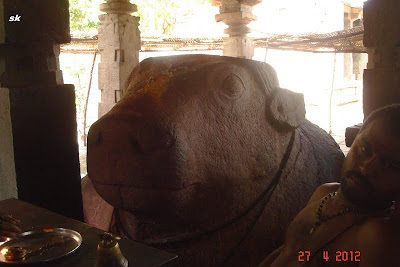
Nandi in the
temple is too big. Archakar says this Nandi
grows at the rate of 1 inch for every twenty year. Initially it was smaller
in its size, and devotees were able to go around it. Nandi is seen in a mandapam. It is to a side of the mandapam and
not in a straight line to main deity. Due to the growth of Nandi already they have removed a pillar.
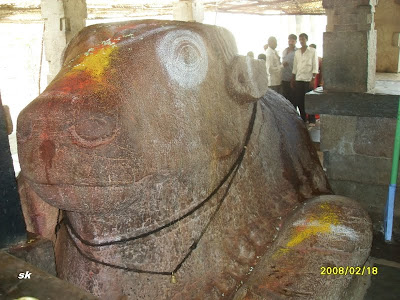
According to Potuluri
Veera Brahmendra Swamy, the Nandi of Yaganti will come alive and shout at the
end of Kaliyugam.

Sthala Purana says
Agasthya Muni was traveling down towards south, and happens to visit this
place. Looking at the secnic beauty of this place he wanted to construct Temple for Lord Venkateswara. The idol that
was made, to install in the temple, was broken near the toe nail and sage was a
bit upset and he started penancing in a cave here. Lord Siva appeared in front of Agyasthya,
who tried to find the reason for what has happened. Lord Siva replied him that the place appears like Kailash surrounded by mountains which
is more suitable for Siva Temple. Agasthya
muni requested Lord Siva to give
darshan along with Goddess Parvathy, as
Uma Maheswarar on a single stone for devotees to worship. Siva obliged to
him, and stayed here in Yganti as Uma
Maheswarar.
When sage Agasthya
was performing penance, the crows disturbed him. So he cursed the crows, as not
to enter the place. From that time onwards crows are not seen in Yaganti kshetra. Devotees, who worship
here, need not fear about Saneeswara
Bhagawan, since crow is his Vahan. We do not see Navagraham in this Siva temple.
A devotee by name Chittappa
worshipped Lord Siva, to whom Lord gave darshan as a Tiger. Chittappa was able see Lord
Siva, in Tiger and he shouted “Neganti
Shivunnu ne kanti” Which means I saw Siva I saw) and danced in joy. Over a
period the place was known as Yaganti.

Agasthya cave:
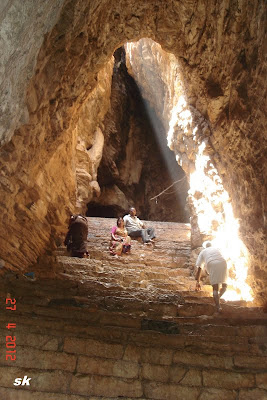
We have to climb about 100 steps inside the cave to reach
the top.
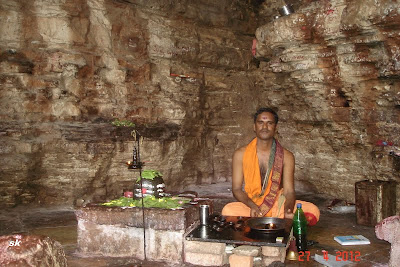
Agyastya penanced and
worshiped Lord Siva.
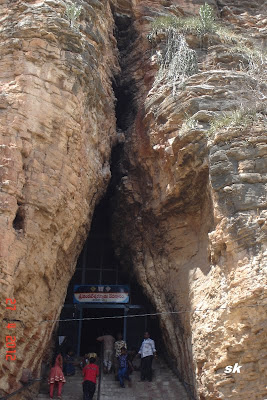
Venkateswara cave:

The steps are steep here. We see the moorthy of Sri Lord Venkateswara, to which the toe
is damaged.
Veera Brahmam cave:

We find steps leading to Brahamam gari cave.
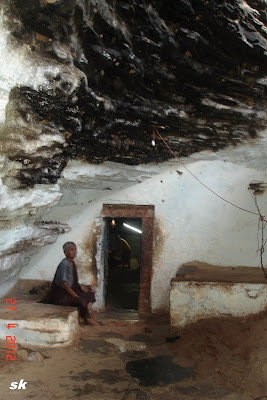
Here we have to climb steps to reach the entrance of the
cave. The entrance is too low and one has to bend, to enter inside the cave
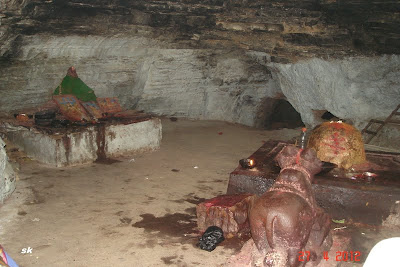
Here inside we find Siva
Lingam and Nandi.
Sthala Purana
says this is the cave where Viswakarma Brahmin, Saint Sri Potuluri Veera Brahmam
wrote some of his “Kala Gyanam.”
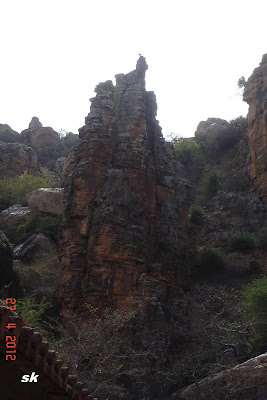
Here on the top of
mountain cliff at the back of Uma
Maheswara Swamy temple, lamp is lit in the evening. Devotees can pay for
the lighting of lamp on the mountain cliff.
Thiruchengkodu: Ardhanareeswarar Temple.
We traveled from Bhavani to Thiruchengkodu temple. The distance is about 25 kms. The hill is red in colour.
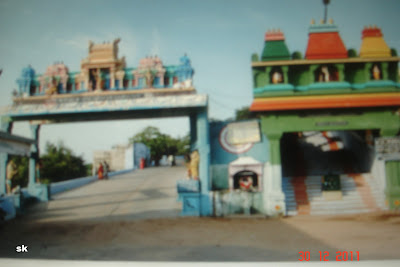
We find an arch at the entrance, with a road leading up for vehicles and steps, for pedestrians to climb. One has to climb 1200 steps to reach the temple door.
This is One of 275 Devara Sthalam of lord Siva.
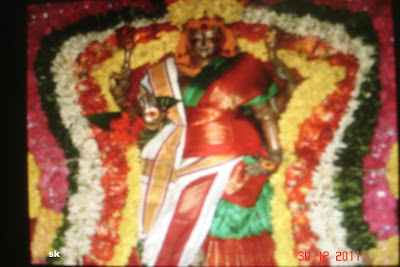
Ardhanareeswarar is one of 64 manifestation of Lord Siva, representing the unity of Sakthi and Siva. This is the one of the temple dedicated for Ardhanareeswarar as main deity. Normally Lord Siva is seen in Lingam form but here He is in human form.
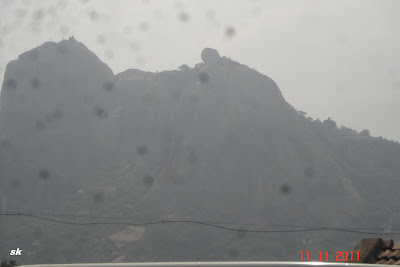
The Hill is in the Lingam form, and it looks like the union of Lord Siva and Sakthi as one.
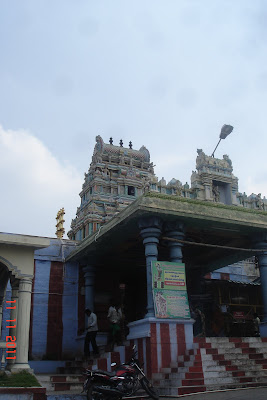
The main Raja gopuram is of five tiers.
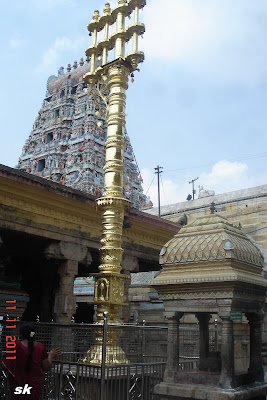
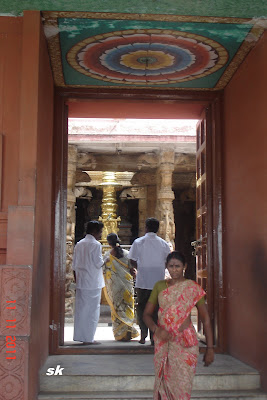
As we enter the main door we find Dwajasthambam. There is a mandapam with pillars having sculptures of various deities.
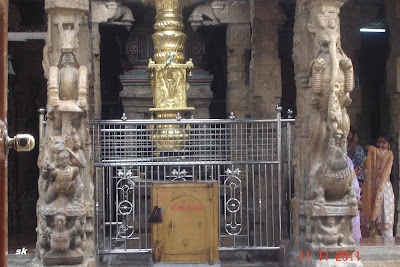
From here, we enter into to Murugan sannidhi, who is known as Thiru Chengkottu velavar. Chengkottu Velvar is as popular as Lord Ardhanareeswarar. Arunagirinadhar has contributed songs for Velavar of this temple in his Thirupugazh.
Main Deity is Swayambu Navabashana Ardhanareeswarar and Ambaal here, known as Bagampiriyaal. Ardhanareeswarar is a combination of Lord Siva and Parvathy. Right side of the deity is Lord Siva and the left side Ambaal. During Aarthi time, poojari will show near the leg where we can have darshan of four legs of Lord Siva and Ambaal Parvathy.
Teertham is known as Deva teertham which flows under the feet of Ardhanareeswarar.
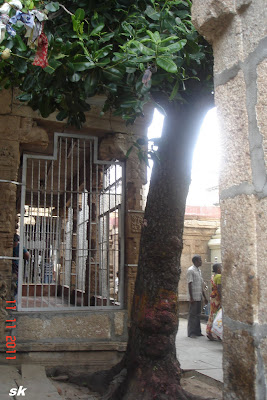
Sthala Vruksham: Iluppai Maram.
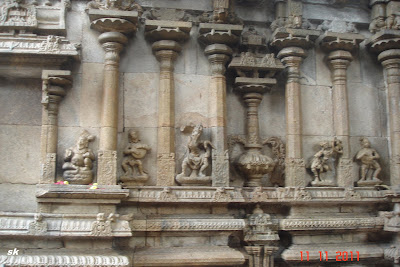
We find beautiful sculptures to the side walls of temple when we go around the temple.
Sthala Purana: Bringy Muni, was great devotee of Lord Siva and used to worship only Lord Siva. One day when Lord Siva and Parvathy Devi was together, Bringi Muni came to worship Siva; he took the form of BEE, and worshiped only Lord Siva and ignored Sakthi who was next to Lord Siva. Parvathy got agitated with Bringi, for his ignorance of not knowing power of Goddess Sakthi. She cursed him to loose his power for neglecting Her.
Lord Siva showed Bringui muni, his original form of Ardhanareeswarar, which is the form of Siva and Parvathy as one. There is a sculpture of Bringi Muni in the temple.
Importance: The Hill is in red colour. Once, “Adi seshan and Vayu Bhagawan” wanted to test who is powerful among the two. The condition was, “Adiseshan” should hold the mountain tight with his head and “Vayu” should release himself from the grip. When Adiseshn holded Vayu with his hood. Vayu blew fiercly and the mountain pieces fell at many places. The hill is known as Thiruchengkodu. The hill is in red colour, because of the blood that oozed when Adiseshan pressed Vayu bagwan, with his hood. The hill is also known as Nagagiri and Vayu malai.
Inside the temple premises we see a small sanctum for Adiseshan
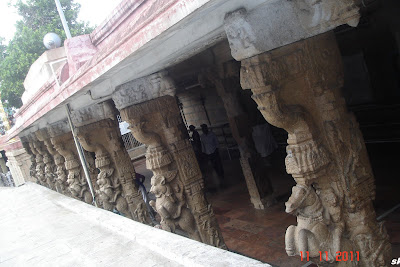
We see these pillars, as we go around.
As we go around the temple there is a separate shrine of Adi Kesava Perumal with dwajasthambam in front.
We see other deities like Vinayakar, Viswanadhar and Visalakshi, Natarajar and Sivakami ammai, Siddhi Vinayakar, Adi seshan, Sooryan, Bairavar, and Navagraha.
Thiru Gyana Sambandhar sang Hymns on Lord Siva.
We traveled from Bhavani to Thiruchengkodu temple. The distance is about 25 kms. The hill is red in colour.
We find an arch at the entrance, with a road leading up for vehicles and steps, for pedestrians to climb. One has to climb 1200 steps to reach the temple door.
This is One of 275 Devara Sthalam of lord Siva.
Ardhanareeswarar is one of 64 manifestation of Lord Siva, representing the unity of Sakthi and Siva. This is the one of the temple dedicated for Ardhanareeswarar as main deity. Normally Lord Siva is seen in Lingam form but here He is in human form.
The Hill is in the Lingam form, and it looks like the union of Lord Siva and Sakthi as one.
The main Raja gopuram is of five tiers.
As we enter the main door we find Dwajasthambam. There is a mandapam with pillars having sculptures of various deities.
From here, we enter into to Murugan sannidhi, who is known as Thiru Chengkottu velavar. Chengkottu Velvar is as popular as Lord Ardhanareeswarar. Arunagirinadhar has contributed songs for Velavar of this temple in his Thirupugazh.
Main Deity is Swayambu Navabashana Ardhanareeswarar and Ambaal here, known as Bagampiriyaal. Ardhanareeswarar is a combination of Lord Siva and Parvathy. Right side of the deity is Lord Siva and the left side Ambaal. During Aarthi time, poojari will show near the leg where we can have darshan of four legs of Lord Siva and Ambaal Parvathy.
Teertham is known as Deva teertham which flows under the feet of Ardhanareeswarar.
Sthala Vruksham: Iluppai Maram.
We find beautiful sculptures to the side walls of temple when we go around the temple.
Sthala Purana: Bringy Muni, was great devotee of Lord Siva and used to worship only Lord Siva. One day when Lord Siva and Parvathy Devi was together, Bringi Muni came to worship Siva; he took the form of BEE, and worshiped only Lord Siva and ignored Sakthi who was next to Lord Siva. Parvathy got agitated with Bringi, for his ignorance of not knowing power of Goddess Sakthi. She cursed him to loose his power for neglecting Her.
Lord Siva showed Bringui muni, his original form of Ardhanareeswarar, which is the form of Siva and Parvathy as one. There is a sculpture of Bringi Muni in the temple.
Importance: The Hill is in red colour. Once, “Adi seshan and Vayu Bhagawan” wanted to test who is powerful among the two. The condition was, “Adiseshan” should hold the mountain tight with his head and “Vayu” should release himself from the grip. When Adiseshn holded Vayu with his hood. Vayu blew fiercly and the mountain pieces fell at many places. The hill is known as Thiruchengkodu. The hill is in red colour, because of the blood that oozed when Adiseshan pressed Vayu bagwan, with his hood. The hill is also known as Nagagiri and Vayu malai.
Inside the temple premises we see a small sanctum for Adiseshan
We see these pillars, as we go around.
As we go around the temple there is a separate shrine of Adi Kesava Perumal with dwajasthambam in front.
We see other deities like Vinayakar, Viswanadhar and Visalakshi, Natarajar and Sivakami ammai, Siddhi Vinayakar, Adi seshan, Sooryan, Bairavar, and Navagraha.
Thiru Gyana Sambandhar sang Hymns on Lord Siva.
Befriend on Facebook

Contributors

My Other blogs


Copyright

Ancient Temples of India by http://ancientindiantemple.blogspot.com/ is licensed under a Creative Commons Attribution-Noncommercial-No Derivative Works 2.5 India License.
LinkWithin

Subscribe to my posts


 Posts
All Comments
Posts
All Comments