Sri Nanjundeswarar Temple of Nanjangud, Karnataka.
Nanjangud is about 165 kms from Bangalore and about 25 kms from Mysore. The temple town Nanjangud is located on the banks of the River Kabini. Nanjangud town is located on the confluence of River Kabini/ Kapila, River Koundinya and River Manikarnika. The place is also known as Dakshina Kasi.

Sri Nanjundeswara temple is one of the ancient temples that dates back to 3rd
Century. The original temple is referred to Ganaga period. It was later renovated by Hoysala Kings, Wodeyar Kings, Hoysalas, Cholas, and Krishnadevaraya. Hyder Ali and Tippu sultan have allotted grants for the temple.
Main Deity of the temple is Siva Lingam known as Nanjundeswarar / Sri Kanteswara and his consort known as Parvathy. Urchavar in this temple is known as Chandrashekarar.
Sthala Vruksham is Vilvam and Teertham is Mukkudal.

The main Raja Gopuram of the temple is of seven tiers. As we enter inside a big Nandi is seen. The main deity Nanjundeswarar is facing north east. Here we see the Nandi is moved towards northeast side and not in a straight line to Lord Siva.
Here in this temple Dakshyayani is seen with Veerabadharar. Normally Badrakali is seen with Veerabadrarar in temples.
The reason for this is Dakshan performed a Yagam in which he refused to give Aahuthi for Lord Siva. Dakshyayani jumped into the Yagna kundam to stop the Yagam. Lord Siva was annoyed and his anger took the form of Veerabadrar, who went to stop the Yagam. Veeerabadrar destroyed the Yagam and removed the head of Dakshan. Even after this his anger did not minimize, He lifted Dakshyayani body to his shoulder and performed Rudhra Thandavam. Dakshan’s wife Prasuddha Devi requested Lord Siva to forgive Dakshan. She requested him to give life to both Dakshan and her daughter Dakshyayani. Lord Siva was pleased with her and he gave life to Dakshan and blessed both of the along with Dakshyayani.
Sthala Purana says Asura named Kesi was troubling Devas. So they requested Lord Siva to help them. Kesi is full form of poison. Lord Siva asked Devas to perform yagnam at the place where these Rivers Kapila, River Koundinya and River Manikarnika confluence. Lord said, when Kesi comes there to trouble them; they should try to throw him in Yaga Kundam. Devas did as they were told,Lord Siva was in the form of Agni in Yaga Kundam and destroyed Kesi. Devas were pleased and requested Lord Siva to stay back in that place for sake of “ lokakalyanam.” Asura Kesi being the form of poison {Nanju} was destroyed by Lord Siva. When Lord Siva appeared there as Swayambu Linga Moorthy, he was known as Nanjundeswarar.
There is another version which says when Jamadagni muni asked Parasuramar to cut his mother Renuka Devi’s head. Parasuramar did as his father told him. To get rid of the dosha acquired by him in cutting his mother’s head, he was advised to erect Siva Lingam and worship. When he was in the place Nanjankud he wanted to install a Siva Lingam to worship. He started clearing the bushes in the area and his axe hit on something in the bush and blood started oozing. He saw a Siva Lingam there. He was worried of his act, and wanted to sacrifice his life. Lord Siva appeared and blessed him. He built a temple there and worshiped Lord Siva. There is a cut in the Siva Lingam here.
Lord Nanjundeswara is also known as “Vaidya Nanjundeswara” who is a healer for his devotees who have faith in Him.
There is a story related to call him so. Once Tippu Sultan’s elephant lost eye sight, he worshiped Lord Nanjundeswara with firm faith. The elephant recovered eye sight and Nanjundeswara was addressed as “Hakim Najundeswara” by Tippu Sultan. Hakim means Doctor. He donated an Emerald Siva Lingam for the temple.
As we go around the prakarm sanctum for other deities seen here are Narayanar, Chandikeswarar, Nandi, and Nruthya Ganapathy, Nayanmars and Sahasra Lingam. To one side of the prakaram we see on a platform, stone idols Lord Siva in different forms, emerald Siva Lingam, Nagaraja with Subramanyar in the centre, Chandikeswarar in standing posture, and Navagraha's are arranged in line. We see Yoga Dakshina Moorthy with his disciple and Nandi is also present there which is something rare.

This is a Picture of one of the temple Charriot. We saw many charriots in the ground, outside the temple.
This is one of the temples which I liked very much and I wish everyone visit the temple to appreciate the beautiful idols seen in the temple. It is not that easy to express in words one has to enjoy the moment when they visit in person.
Alampur:
Alampur is about 200 kms from Hyderabad on the banks of River Tungabadra in Mahaboob Nagar district of Andhra Pradesh. River Krishna and Tungabadra confluence here and the place Alampur is known as Sangama Kshetram and it is also referred to as Dakshina Kailsam.
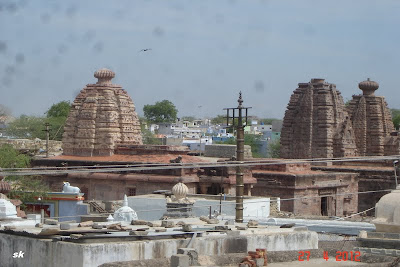
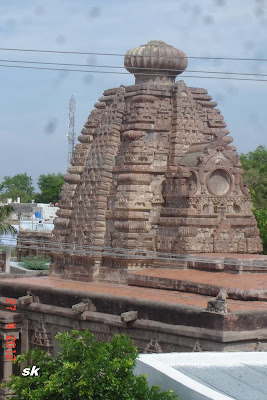
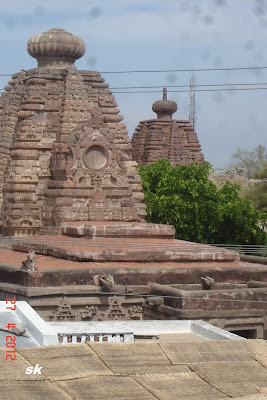
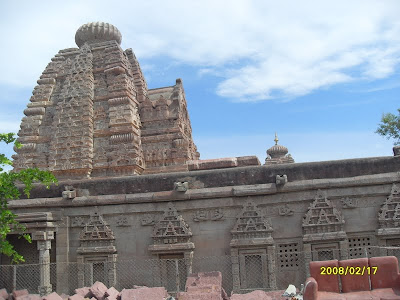
View of temple towers of Nava Brahma, from River bund.
The temple dates back to 6th Century. We see 9 temples here in Alampur, known as Nava Brahma dedicated to Lord Siva, built by Badami Chalukyas. The Nava Brahma temples are Taraka Brahma, Swarga Brahma, Padma Brahma, Bala Brahma, Garuda Brahma, and Arka Brahma, kumara Brahma, Veera Brahma and Viswa Brahma.
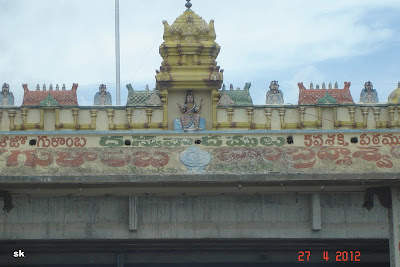
We travel towards Karnool from Hyderabad to reach Alampur. We take a left turn when it is about 15 kms to reach Karnool. We have a sign board on the highway.
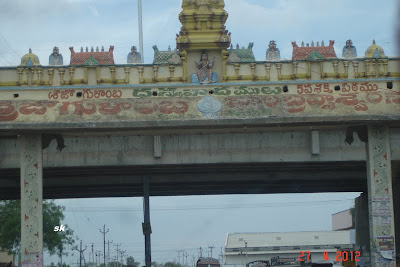
As we travel ahead we see an arch welcoming us to Jogulamba temple. From there we may have to travel about 12 kms to reach the temple in Alampur town.
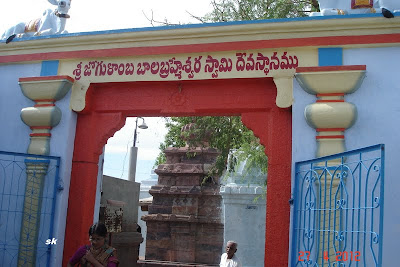
Bala Brahma Temple is the place, where we enter first. As we enter inside we see a huge Nandi and two set of padams which is supposed to be of Lord Siva and sakthi. Then we enter into a mandapam where we see idols of Narashimar, Lord Siva and others.
There is a sanctum for Ganesha and next to it there was a small sanctum with a light. They it was the place where Goddess was kept.
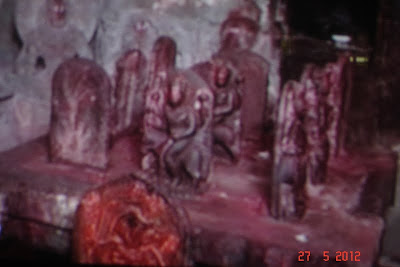
We see Navagraha’s which are different from the usual type of idols in other temples.
We enter into Artha mandapam, from where we can see Lord Siva in Linga form in the main Garbha graham. Here they say the water poured on Siva Lingam as Abishekam does not flow out anywhere. With special ticket of Rs300/ for Abishekam, devotees are permitted inside the main sanctum to perform abishekam.
We see two small idols in sitting posture outside the main Garbha graham which are called as Chandi and Mundi. These two idols were originally kept to either sides of Jogulamba. As we go around the temple sanctum we see many idols.
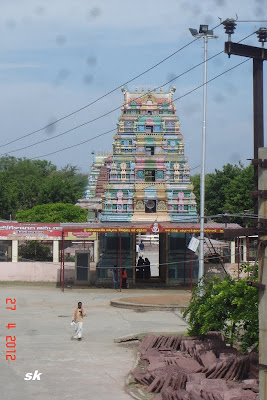
We see south Indian style of temple tower for Jogulamba Temple. The temple was reconstructed in the year 2005. As per Mythology this is one of the Sakthi peetam, where “Oordhava Danta Pankthi” (Upper jaw with tooth) of Sati Devi fell here in this place.
In the year 1930 the temple was demolished by Muslim invaders. The main idol and consorts were damaged by them. Disfigured idols of Jogulamba and other Deities were, protected and repaired by devotees who placed them in Bala Brahma temple.
Goddess Jogulamba is seen in sitting posture. She is also known as Gruha Chandi.When Aarthy is given one can see Bat, Lizard, Scorpion and skull adorned in her hair.
As per legand Maharishi Jamadagni lived with his wife Renuka Devi and his sons worshiping Bala Brahma Swamy. Renuka matha used to make a pot of mud daily and used to fetch water for pooja purpose. One day she saw a Gandrvas bathing in River with their wives. She was disturbed by them and was not able to make a pot on that day, she returned home empty handed. When Jamadagni Muni came to know about what has happened, in his anger he asked his son to remove her head. His sons were not ready to do the act and he cursed them. Parasurama his youngest son agreed to do and he cut the head of his Mother. Muni was pleased with his son and offered him boon. He prayed his father to give life to his Brothers and Mother in return for the boon. Life was given to them.
Legend says that head of Renuka Matha became Ekaveera Devi symbol of Maya Roopa and the headless body became Boodevi Synmbol of Matru roopam.
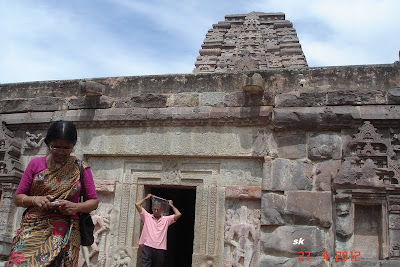
Sri Veera Brahma Temple.
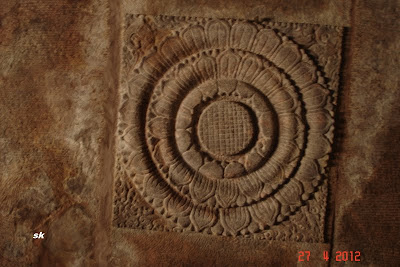
We see Chakkram carved to the inner celing of the artha mandapam in Veera brahma Temple.
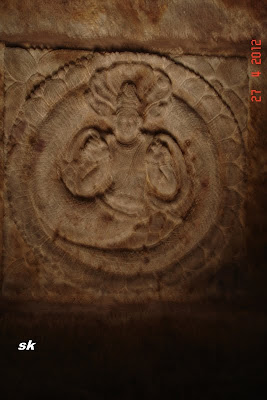
Veera Brahma sculpture carved to the inner celing of the artha mandapam.
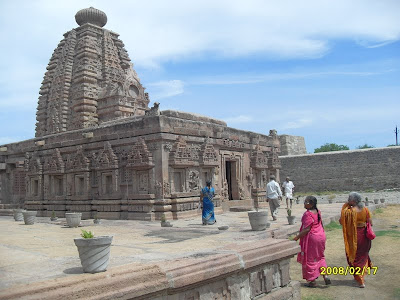
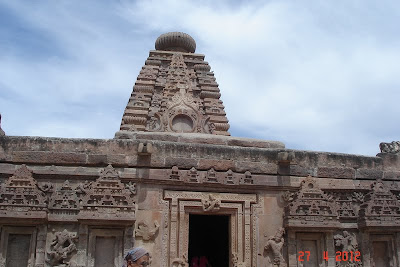
Sri Viswa Brahma Temple.
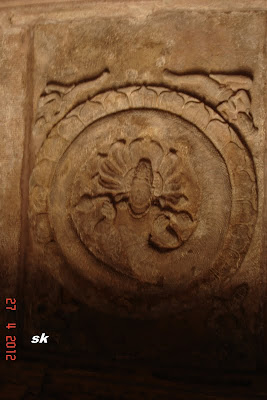
Sri Viswa Brahma Sculpture carved to the inner celing of temple.
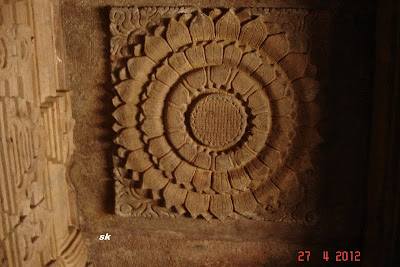
Chakkram, is seen to inner celing of Viswa Brahma Temple.
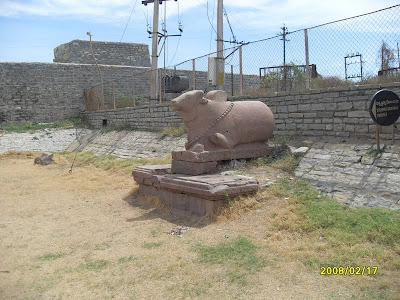
Nandi , seen in front of Sri Viswa Brahma Temple.
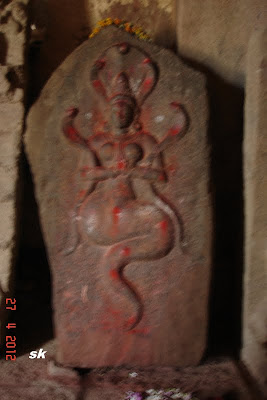
Naga Devata, sculpture seen in Arkka Brahma Temple.
Befriend on Facebook

Contributors

My Other blogs


Copyright

Ancient Temples of India by http://ancientindiantemple.blogspot.com/ is licensed under a Creative Commons Attribution-Noncommercial-No Derivative Works 2.5 India License.
LinkWithin

Subscribe to my posts


 Posts
All Comments