The temple is in Kancheepuram district. The place is about 20kms west of Singaperumal koil, on Chennai – Vizhupuram National High way.
This is a very old temple of more than 1000years constructed by King Bageerathan, who was ruling Sankondpuram of Ilanji Kingdom.
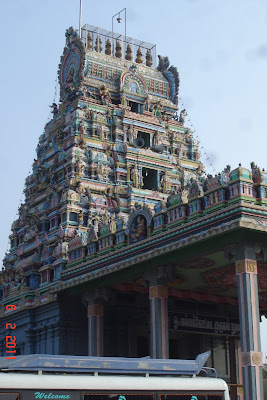
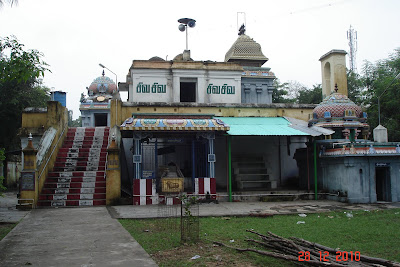
The temple has main Raja Gopuram of five tiers with a big mandapam to front.
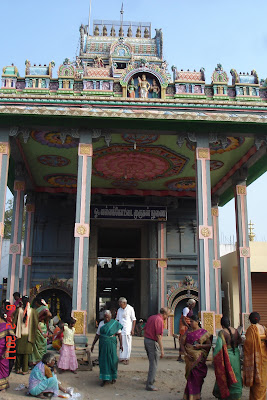
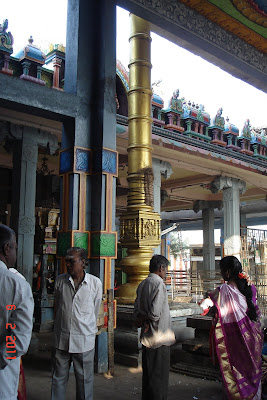
As we enter inside through the main door, we find a big Dwajasthambam
Main deity is Arulmigu Subramanya Swamy with Valli & Devasena. Arunagirinadhar sang Tirupugazh on Lord Murugan of this temple.
Here, the pushkarani of the temple is known as Vajra Teertham and Sthala Vruksham is Padiri tree.
Indara wanted to worship Lord Murugan. He approached his Guru Brahaspathyto guide him. Indra was asked to worship Lord Subramanya of Vallakottai by his Guru. Indra came to this place and he used his weapon Vajra to make a pond. He used the water from the pushkarani to worship Lord Subramanya. Hence the pushkarani is known as Indra Teertham and Vajra teertham.
There was a fort in which there was an Asura named Vallan. He was giving lot of trouble to Devas, who prayed to Lord Subramanya to help them. Lord Murugan killed the Asura. To fulfill the wish of Asura, Lord Murugan named the place as Vallan Kottai, which became Vallakottai over a period.
Sthala Purana says King Bageeratha was ruling Sankondapuram of Illanji Kingdom. Once when Sage Naradha visited his place he ignored him out of pride. Sage Naradha wanted to teach him a lesson. When he left the place he met asura named Koran who was celebrating his victory. Sage thought he can use Koran to teach a lesson for King Bageerathan. He addressed Koran and said your victory is nothing unless you defeat King Bageeratha. Koran waged war against Bageerathan King of Illangi. It was least expected, and Bageeradhan lost the battle and left the kingdom.
In the forest he met Sage Naradha, and begged for pardon. He asked him to guide, to get back his kingdom again. Sage Naradha asked him to meet Sage Durvasa and proceed according to his guidance. Sage Durvasa asked him to worship Lord Subramanya under the Padiri Tree on Fridays and get the blessing of Lord Murugan. King did as he was asked and he was blessed. King Bageeradha constructed a temple for Lord Subramanya in this place and the padiri tree is sthala Vruksham of the temple.
Arunagirinadhar was on visit to Murugan temples. After his visit to Thiru Porur he wanted to proceed to Thiruthani and rested for the night. In his dream Lord Subrananya said you have missed Vallakottai Murugan. Next day Arunagirinadhar visited Vallakotai Murugan and sang Thirupugazh on Lord Subramanya.
Sree Vajreswari Yogini Devi Mandir.

The place Vajreswari town is on the banks of River Thansa in Bhawandi Taluk of Thane district, Mumbai. Our stay in Mumbai was at Goregaon. From there the temple was about 65 kms.

The temple is seen on the Mandagiri hillock, on the road, which was formed out of a volcanic eruption and is surrounded by hills on all sides. We see Nagarkhana in main entrance gate. The history says it was built by “Gaikwads, Maratha Dynasty.”


We have to climb about fifty two steps which lead us to the main entrance of temple. As we climb the steps mid way we see Tortoise carved on the stone and which is shielded by brass metal. To the side wall we see a board about the history of the temple written in Marathi Language.

Once we enter the temple we see a big hall with pillars and marble lion seated on a mount. We enter into another mandapam, where we see Ganesha, Parasurama, and Bairava to one side and local deities likeMorba Devi and Kalika with kamandalm.
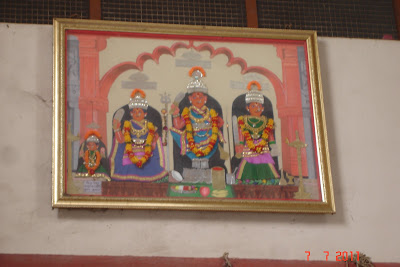
In the main inner sanctum we see Goddess Vajreswari, with Gada and Sword on either hand. Next to her we see, Trisul and Renuka Devi (Parasuram Mother) with Sword and Lotus in her hand. To other side of Vajreswari matha we see Matha Sapthasrungi. All deities are seen in saffron colour. The goddesses are adorned with silver jewelry, crowns and stand on silver lotuses. The inner ceiling is concave.

As we exit through the side door we see a sanctum for Lord Kapileswar. There is a stone Deepa sthambam.
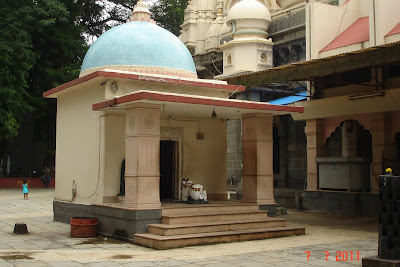
Inside the main sanctum Lord Kapileswar is in Lingam form and we see Matha Parvathy mounted to wall at the back of Siva Lingam.
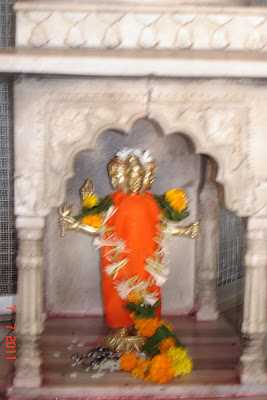
As we go around the main sanctum we come across sanctum ofDattatreya where we see a brass idol of Datatreya installed.

Samadhi (tomb) of the 17th century Giri Gosavi saint Godhadebuwa is further on top of the Gautam hill, behind the Mandagiri hillock. As we start to climb there is a sanctum for Lord Hanuman. From the top of the hill we can see the River Thansa.
Purana: The region of Vadavali is mentioned in the Puranas. The legend says Parshurama performed a Yajna at Vadvali and, the hills of volcanic ash in the area are its residue.
The primary deity of the temple, Vajreswari is considered as incarnation of goddess Parvarhy or Adi Maya on earth. Her name literally means "the lady of the Vajra (thunder bolt). There are two legends about the goddess' origins, both associated with the Vajra.
Another legend says that Indra and other Devas went to goddess Parvathy, to request her help in slaying the demon Kalikala. Goddess Parvati assured that she will come to their aid at the right time and ordered them to fight with the demon. In the battle, Kalikala swallowed or broke all weapons thrown at him. Finally, Indra threw the Vajra at the demon, which Kalikala broke into pieces. From the Vajra, emerged Goddess, who destroyed the demon. The Devas worshiped her as Vajeswari and built a temple for her.
The history says original temple of Thousands of years ago, a Rakshas named Kalikala troubled the sages and humans in the region of Vadvali, and waged a war against the Devas. Devas and sages headed by Vashishta performed Trichandi Yagna (fire offering to the Goddess) to please Her. They did not give an aahuti (offering of ghee in yajna) to Indra (king of devas). Enraged, Indra hurled his Vajra, one of most powerful weapons at the yajna. The terrified gods and sages prayed to the Goddess to save them. The Goddess appeared in all her glory at the site and swallowed the Vajra and killed the Rakshas.Indra was also blessed by her. Rama requested the Goddess that she should stay in the region of Vadvali and be known as Vajreshwari. Thus, the Vajreshwari temple was established in this region.
Vajreswari temple was at Gunj about 8 kms north of Vadavli. It was moved to Vadvali after its destruction by the Portugese. Chimji Appa is the younger brother and military commander of Peshwa Baji Rao 1. He set a camp in the Vadvali region. On his way to capture the Portuguese held Bassein Fort of Vasai, which was unconquerable even after a three-year war.

Chimaji appa prayed to goddess Vajreshwari. If he could conquer the fort, and defeat the Portuguese, he would build a temple to the goddess. According to legend, goddess Vajreshwari appeared in the dream of Chimaji Appa and told him the way to conquer the fort. He was able to defeat Portuguese and conquor fort in Vasai. To celebrate his victory and to fulfill the vow taken in front of goddess Vajreshwari, Chimnaji appa ordered the new Subhedar (governor) Shankar Kasav Phadke to build the Vajreshwari temple. The temple' architecture is based on Bassein Fort.
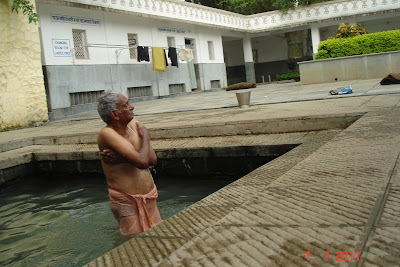
There are about twenty one hot springs in Vajreswari area within a range of five kms. Taking bath in Hot water springs cures ailments. Hot water spring is seen in ganeshpuri
Nannilam / Madhuvanam:
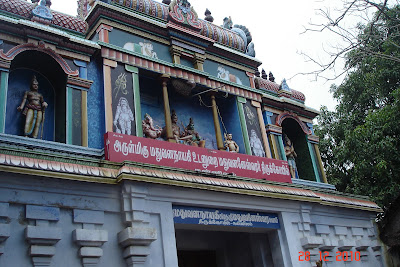
Madhuvaneswarar Temple is known as Nannilam Perungkoil on the banks of River Mudikondan. This is one of 275 Siva Devara sthalam. It is a Madakkoil built by Cochengat cholan. There are two prakaram.
The temple is in the town Nanilam which is about 25 kms from Mailaduthurai and about 15 kms from Thiruvarore. The place is also known as Devaranyam, and Bragathpuram
Main deity is swayambu Lingam known as Arulmigu Madhuvaneswarar / Prakasa Nadhar, and his consort known as Periya Nayaki / Prakasa Nayaki.
Sthala purana says Devas worshiped Lord Siva from this place and hence the name Devaranyam. Teertham is Deva teertham. Yama, Varuna, Indra and Kubera installed Siva lingam and worshiped in this place.
Since it is a madakoil we have to climb few steps to reach the main sanctum. We see Agasthesar in the ground level first prakaram.
Sundarar sang hymns on Lord Siva of this place.
[Devaranyam][Madak Koil] [Sundarar][Cochengat Cholan]
Madhuvaneswarar Temple is known as Nannilam Perungkoil on the banks of River Mudikondan. This is one of 275 Siva Devara sthalam. It is a Madakkoil built by Cochengat cholan. There are two prakaram.
The temple is in the town Nanilam which is about 25 kms from Mailaduthurai and about 15 kms from Thiruvarore. The place is also known as Devaranyam, and Bragathpuram
Main deity is swayambu Lingam known as Arulmigu Madhuvaneswarar / Prakasa Nadhar, and his consort known as Periya Nayaki / Prakasa Nayaki.
Sthala purana says Devas worshiped Lord Siva from this place and hence the name Devaranyam. Teertham is Deva teertham. Yama, Varuna, Indra and Kubera installed Siva lingam and worshiped in this place.
Since it is a madakoil we have to climb few steps to reach the main sanctum. We see Agasthesar in the ground level first prakaram.
Sundarar sang hymns on Lord Siva of this place.
[Devaranyam][Madak Koil] [Sundarar][Cochengat Cholan]
Befriend on Facebook

Contributors

My Other blogs


Copyright

Ancient Temples of India by http://ancientindiantemple.blogspot.com/ is licensed under a Creative Commons Attribution-Noncommercial-No Derivative Works 2.5 India License.
LinkWithin

Subscribe to my posts


 Posts
All Comments
Posts
All Comments