Sri Yogananda Lakshmi Narashima Swamy of Vedadri.
The place Vedadri is on the banks of River Krishnaveni. This place is about 10 kms from Chillakallu, which is on National High way No-9, from Vijayawada to Hyderabad.

Here in this place Lord exists in five forms, different form each other. They are known as Pancha moorthy, namely Jwala, Saligramha, Yogananda, Veera and Lakshmi Narashimar. Hence the place is known as Vedari.

The temple has Raja Gopuram of five tiers to east and west side. The lower portion of Dwajasthambam is seen inside the mandapam. There is Artha mandapam and Garbha graham.
As we enter inside, to left there is a sanctum for Chenchu Lakshmi Thayar.
Main deity is Yogananda Narashimar erected by Rishyasringa Muni, and on his own peetam as Laksmi Narashimar in the same sanctum. Rajya Lakshmi Thayar is seen in separate sanctum to left side of main sanctum.

West side Gopuram is facing River Krishnaveni. Here in the River we see Narashimar in the form of Saligrama. We find steps leading to Sikaram. Here we see Jwala Narashimar as deity.
About 5 kms away there is Garudathri were Lord Sriman Narayana has incarnated himself as Veera Narashimar.
Sthala Purana: Sownakadi muni explains to Sanakadhiyar and to Rishis, about Brahma purana. In this purana it says Somakasura took the Vedas from Lord Brahma, who approached Lord Sriman Narayana to help him in getting back the Vedas. Sriman Narayanar in the form of Matsya, killed the demon Somakasura and brought the Vedas back in tact. As a gesture Vedas thanked Lord Narayanar in human form and requested Him to stay back on their head. Lord agreed to fulfill their wish, after Hiranya vadam.
He said he would stay here as Pancha Moorthy. He asked Veda Prussia’s to stay here as Saligrahama Mountain, on the bank of the River Krishnaveni. He said he has granted a boon for Krishnaveni also. She has requested Him, to allow her to pray and worship everyday. Lord said wishes of Veda Prussia’s and River Krishnaveni will be fulfilled simultaneously. After Hiranya Vadam, Sriman Narayanar stayed back on the Vedadri Sikara as Jwala Narashimar and fulfilled Veda purusha’s wish.
Brahma requested Jwala Narashimar to stay in Sathya lokam as Saligramha Narashimar. Lord. Sriman Narayanar went to Sathya Lokha with Brahma. Even before Lord Brahma offered his worship to Lord in Sathya Lokha, fire took place. So Lord Brahma brought Saligrahma moorthy to the River Krishnaveni and erected the Saligrama Moorthy on Saligrama Mountain. Thus the wish of Veda purusha’s and River Krishnaveni was fulfilled simultaneously.
Rishyasrunga Muni and other Rishi's approached Vyasa Bhagawan, and requested him to show the path of salvation in Kaliyugam. Vyasa Bhagavan said Nama Sankeerthanam is the easiest way to attain Moksha in Kali Yugam. Rishi's went in search of some peaceful place to recite. When they crossed this Veda Sikaram they heard echo of Veda mantra. Here they worshipped Yoga Narashimar and started their penance. They were blessed By Sriman Narayanar as Yogananda Narashimar in this place. Rishyasrungar installed yogananda Narashimar on this Saligrahma Sikaram.
Thiru Kottaram:
This place is One of 275 Devara Sthalam. The place Velangkudi is on the way between Kariakkal and Mailaduthurai. Thiru Kottaram is about a kilometer from Velangkudi.

The Raja Gopuram is of three tiers.
Main Deity is small Swayambu Lingam known as Iravadeeswarar and his consort known as Vandavar Kuzali Amman. She is seen in standing posture.
Sthala Vruksham is Parijatham and Teertham is Vanjiaru and Soorya Teertham. Previously the River was known as Kottaru and now it is known as Vanjiaru.

As we enter we find Dwajasthambam and Dwara Ganapathy. In front of this we see a mandapam, with sculpture of Lord Siva as Kailasanadhar To left we see Bala Ganapthy.

In this mandapam, we see pillars and the roof is in arch shape. Nandi is seen here facing the main sanctum of Iravadeeswarar.
Here in this mandapam to the right, we see Artha mandapam and Ambal sannidhi. From here we enter into Maha mandapam, were we see Natarajar and Sivakami Ammai, Lord Murugan, and Somaskandar. Next we enter into Artha Mandapam were, we see Boga Sakthy as Urchava Idoi to North West corner. Ganapathy and Nagarajar sculptures, is seen to either side of the entrance, which leads to main sanctum of Iravadeeswarar.
As we go around the temple we see other Deities like Ganapathy, Thirumaal, Kailasa nadhar, Nalwar, Paravai Nachiar, Subaka Maharishi, Nagarajar Subramanyar, Gaja Lakshmi, and Chandikeeswarar.
Due to the curse of Durvasa Muni, Iravadham lost its control and hit the clouds with its tusk. Rain started pouring down and water started flowing like a River. Iravadham worshiped Lord Siva with this water. Hence Lord Siva is known as Iravadeeswarar and the place as Kottaru which changed as Kottaram over a Period.
Purana says Agasthya Muni and Subhaka Maharishi worshiped Lord Iravadeswarar here. One day Subha Rishi was late in visiting the temple, by the time the door was closed. He took the form of Honey Bee and worshiped Lord Iravadeeswarar. Honeycomb is seen in front of the sanctum. In this temple once in a year, honey is collected from the homeycomb seen in the temple, which is used for the Abishekam of Siva Lingam.
There is a separate sanctum for Kumara Bhuneswarar and Siva lingam which was installed and worshiped by Agasthya Maharishi and Subhaka Muni.
Sambandhar sang Hymns on Iravadeeswarar.
The temple was built by Kulothunga Cholan in the year 1253AD. Stone inscriptions in the temple refer to the King as Maduranthagan Kulothunga Cholan.
Our next place of visit was to Bagamandala, which is about 40 Kms from Madikere.
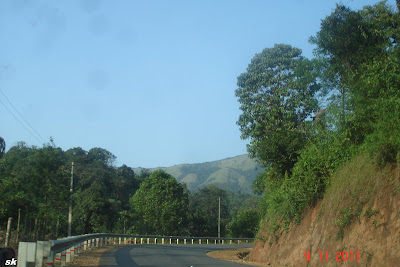
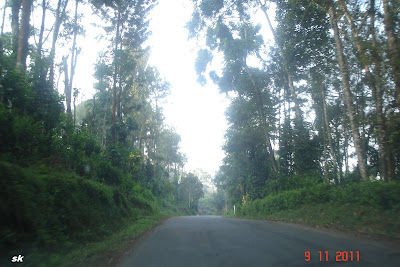
The place Bagamandala is situated at the confluence of two Rivers, Cauvery, and Kannika.
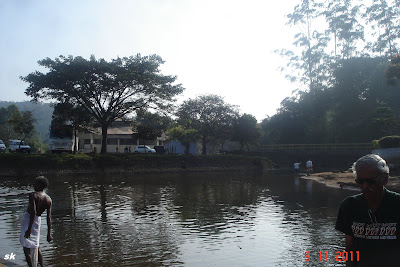
Here another River Sujyothi flow as antharvahini, and join the two Rivers.
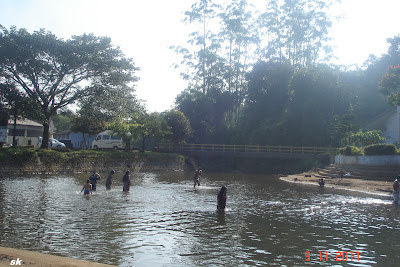
Hence the place is considered as Triveni Sangamam. The place is considered auspicious to have a dip and perform rituals for their ancestors.
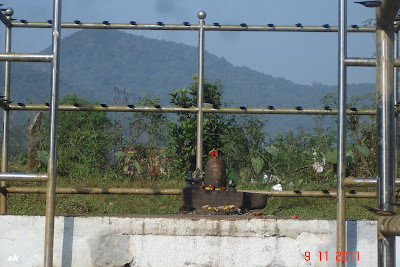
There is a small Siva Lingam seen here.
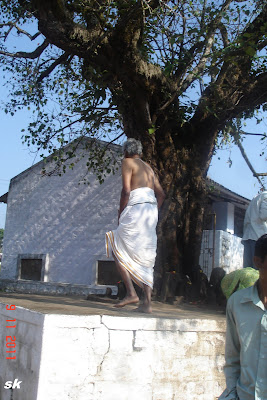
There is a Peepul tree, here and we see lot of Nagar installed.
There is a Siva temple here, in Bagamandala near the sangamam. Lord Siva is known as Sri Bhagandeshwara. The temple was established by a Rishi known as Bagamandala.
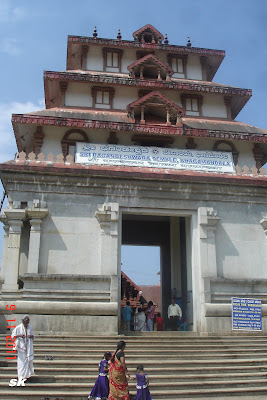
We have to climb few steps to reach the main entrance of the Temple. There is a Raja Gopuram of three tiers for the temple. The temple is constructed in Kerala style.
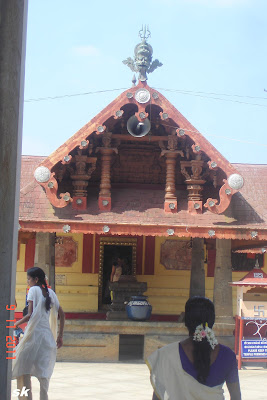
Main deity is Lord Siva in Lingam form known as Bhagandeshwara. There are separate sanctums for Ganapathy, Ambaal, Mahavishnu and Subramanya. Here Subramanya Swamy is Swayambu Moorthy. In front of Lord Subramanya there is a mandapam with wodden carvings relating story of Subramanya
Katteel Durga
Katteel Durga is about 90 kms distance from Dharmasthala. We had to take a turn at Guruvayanakere towards Moodabidri, while traveling from Dharmathala and Mangalore highway. From here the place is about 40 kms.
The River Netravathy is flowing around the temple. The shrine is like an island on the River Netravathy.

There is an arch near the entrance.

We have to cross the River Netravathy,through a small bridge, to enter into the temple.

We see the Gopuram of main inner sanctum of Durga Parameswari.

This is the corridor leading to the sanctum.


Inside the sanctum we to southern side we see Sri Maha Ganapathy and Sastha (Iyappan).In front of Ganapathy we find steps leading us to River Netravathy. They have put grill for safety purpose.
We come to the main sanctum of Goddess Durga Parameswari in sitting posture. The distance is a bit long from were public is allowed for darshan. We had good darshan, but it was not very clear to feel the full satisfaction.

This is the picture of Durga Parameswari to wall. We had a glimpse at it and then we had darshan of Durga Parameswari in the sanctum. We had a little satisfaction after that about our drshan of Matha.

As we go around we see a sanctum which is covered to all three side wall with silver. In it we see a picture of Durga Parameswari in gold sheet framed and hanged to wall.

To side walls we see pictures of Geethopadesam.
We see Kshetrapalakar to south west side within the temple. Beside it Naga Devata is seen.

As we come out this is the main entrance door covered with silver sheet.

Front view of the main temple.

Few yards away Nagaraja is seen on a platform.
Sthala Purana:
When Durga parameswari slew Sumba and Nisumba, Arunasuran, a rakshas ran out of the battle field and became the leader for Rakshas .Arunasura meditated and acquired boon from Lord Brahma. With this grant he lost fear of death. Goddess Saraswathy blessed with Gayatri Mantra. He started troubling Sages; Rishi’s when they were doing Yaga. There was no rain and the people had to suffer out of draught condition.
Looking at the draught condition Japali Maharishi decided to perform Yagna to please Devas. He approached Devandran and requested him to send Kamadenu with him to perform the Yagna. Since Kamadenu was not available at that moment he agreed to give Nandini the daughter of Kamadenu.
Japali Maharishi requested Nandini to come with him. Nandini was not happy with people living on earth and refused to come with him. When Japali Maharishi knew that she was very firm in her decision, he cursed her to flow as a River on Earth. She realized her mistake and prayed for his mercy. Maharishi asked her to pray to Goddess to get free from the curse.
Nandini meditated to Goddess Adi Sakthi. She was pleased with Nandini and asked her to flow as a River and in due course she will be born as daughter to her. She will be purified from the curse of Japali Maharishi She was happy with the assurance Adi Sakthi gave, and emerged from Kanakagiri and started flowing down as River.
Arunasura defeated Devas, who inturn pleaded Adi Sakthi to resque them. She says unless he stops chanting Gayatri Mantra he will not be put into trouble and no one can defeat him. She asked them to send Brahaspathy to distract his meditation from chanting Gayatri Mantra. Brahaspathy flattered him and was able to distract him from chanting Gayatri Mantra.
Goddess appeared as beautiful teenage girl. Arunasura went near her, then she reminde him, about the defeat of Sumba, Nisumban and how he ran away from the battle field. Arunasura got angry and tried to kill her with his sword. Goddess turned into a stone. His sword hit the stone, stream of bees emerged from the stone. He was surrounded by the bees and stung to death.

After entering from the main entrance we see a big rock to left. This rock is known a Rakteswari.
Maharishi Japali performed abisheka with tender coconut water here and requested Bramarambika (Queen of Bees) to bless mankind. Durga Matha appeared in her “Sowmya Roopam “ in the middle of the River. Temple is constructed in the same place.
- Thiru Marugal
Thiru Marugal is one of 275 Siva Devara Sthalam.
Thiru Marugal is about 6 kms from Thirupugaloore and 5 kms from Thittacheri on the banks of River Puttharu. This is a maddakoil.
The temple has a big Raja gopuram of five storeys. There is a big Nandi seen on a platform as we enter through the main entrance.
Vinayakar is known as Vidanteertha Vinayakar. We have to climb few steps to reach Maha mandapam. Here we see paintings relating to the sthala purana. Amman sannidhi is seen in Maha mandapam to a side.
From there we enter into Artha mandapam where we see huge Dwarabalakar near the entrance to main sanctum on either side.
Main deity is Swayambu Lingam known as Maanikkavannar and his consort Vanduvar Kuzhali. Teertham is known as Maanikka teertham / sivagangi, and Sthala vruksham is Plantain. Pushkarani, seen in front of the temple. Marugal means a variety of Plantain.
Sthala purana: Once a Vaisya named Daman gave word his sister, about giving one of his daughter’s hand by marriage, to her son kumaran. He got 6 of his daughter married to, outsider other than Kumaran. The last daughter was worried and she was not happy with her father’s attitude. She left the house to, marry kumaran her cousin.
They left the place and wanted to go somewhere, far from the place. During their travel when they reached the place Thiru Marugl, it was dark and they had to spend the night in a safe place. They decided to stay in the temple that night. Due to snake bite, Kumaran lost his life that night and the girl was left alone. She was confused and started crying.
Thiru Gyana Sambandhar was passing through the village and he heard the cry of the girl. He asked them, about the girl and learned about the mishappenning. He pleaded to Lord Siva and sang hymns on Siva asking for a judgment, for the death that occurred within the compound premises of his temple.
Lord Siva was pleased and blessed him. He gave life to kumaran. Sambandhar got them married in the temple. We see a separate mandapam in the temple relating to the story.
Sambandhar sang hymns on Lord Siva and Arunagirinadhar sang Thirupugazh on Lord Murugan.
[Sambandhar]
[Swayambu Lingam] [Nandi][Snake bite]
Srirangam Saptha prakara parikrama:
We came to know that every year Saptha prakara parikrama is organized by Mrs. Saraswathy and Mr. Sripathy in coordination with “Pejawar matt.”
This year it was on 22, 23 and 24th of October 2009. We availed this opportunity and joined them on 24th October for parikrama. They have arranged stay and food for everyone at “kodiyalayam chattram” at “Srirangam”. Anyone can join for parikrama, and food was arranged separately for Brahmin and others.
This is the contact number for details about saptha prakara parikrama 0431-2436502.
They arranged for sankalpam for cauvery snanam by a prohit, at 3Am and, thereafter every one of us went to River cauveryby van. 20Rs per head was charged for van. After the bath we came back to chattram, for changing our clothing. Then they guided us to starting place of Prakara parikrama.
Srirangam Ranganadhar temple has seven prakaram relating to saptha lokas.
1) Bhoolokam Full of houses and shops.
2) Bhuvarlokam Thiruvikraman Thiru veedhi.(street)
3) Suvarlokam Kili chozan or Agalangan Thirvedhi. (Street)
4) Maharlokam Thirumangaimannan street or Alinadan Thiruveedhi..
5) Janolokam Kulasekaran Thiru veedhi.
6) Thapolokam Rajamahendr chozan Thiru veedhi.
7) Sathyalokam (Garbha graham) Dharmavarma chozan Thiru veedhi.
Main deity Sriranganadhar facing south side, so the parikrama also starts from south entrance of 7th prakaram. Pandit was there along with us till the end of parikrama. He recited mantras which we were asked to repeat and do namaskaram before starting at that place.
We were asked to stop at all corners of four roads, and to the middle of all four roads in front of the gopurams in all seven prakarams which represent Ashtadikbalakars. He recited some namavali and we bowed at all the places.
There is lot of small sanctums, all along the parikrama rounds. We visited only few, but I am trying to give you some more which are important. This we can make it only if we go on our own and not with the group.
7th prakaram of Srirangam temple.
Our parikrama stared mid way of South Chittirai veedhi”,” Kattai gopuram” entrance. This is to mid way of the road. The road is full of shops. There is a mandapam in which there is a small sanctum in basement with deity known as padhala Kannan”.
We took a turn towards west and the street is known as chittrai thiru veedhi or Raja veedhi. We find houses to both sides of the roads. We enter to north Side Street known as Mela chittrai veedhi. Here we see a Hanuman temple in this street.
We enter east side road known as North chittrai veedhi. In the starting of the road we see “Hayagrivar and Desikar” sanctums, and the building looks like a matt.
Next we took a turn towards south and it is known as South chittirai veedhi. We find a ratham which looks like a pushpaka vimana known as Goratham“.
Now we enter into 6th prakaram, from south entrance of kattai gopuram. Sankam and Chakkram are kaval deivam of this gopuram. The street is named after choza raja, as Thiru Vikraman veedhi There are shops in these roads and it is a commercial business centre.
We took a turn towards west. The road is also known as “utthira veedhi”. We find a ratham here and archakar’s houses. Here the houses are to one side and to the other side of the road we find a big wall.
We took a turn to north side which is named as “Mela uttira veedhi”. Next we turned towards east side and the road is known as“North uttrai veedhi”. We find Sriranga Narayanar Jeeayar matt in this road.
We turned towards south side, road is known as Keezai uttirai veedhi”. We have darshan of Hanuman temple. At the end of the road we turn south and this is South uttira veedhi. There is a matt with Manavala Mamunigal sanctum. Half way of the road we reach Nanmugan kottai vassal
.
We started our 5th Prakaram
Two Devas Dharmathyakshar and Niyantha are kaval deviam, {security}. The street is also known as Agalanganin thiru chuttru”. Here we start from north side and we see a mandapam with four pillars. To one pillar we see Kavi arasar Kambar in standing posture. To left of this mandapam there is a sanctum for Nadha muni, his deciple Thiruvaranga perumalariarum, and Alavandhan grand son of Nadha muni.
We see Andal sanctum and we next come to Venuganan sanctum, which is very old one. We find Ranga vilas of Nayakar’s contribution which is full of beautiful sculptures. We take a turn to west and as we pass, we find Chakkratazwar sanndhi. At the back of the sanctum we see small ventilator through which we can have darshan of “Narashimar”.
We proceed towards north and we come across Vasantha mandapam Here we cross a grill gate and enter inside and we see Ranganayaki Thayar sanndhito left. We find Hanuman to a pillar near the entrance of the sanctum and we take a round and enter the temple.
The main deity is also known as padidanda pathini”, hence all the festivals concern to her are celebrated within the temple only. We see urchava vigram in the front and 2 main deity at the back.
Old moolavar was hidden under the Vilava tree during Muslim invasion. After the war, they were unable to locate and find out and new Thayar idol was installed. After sometime they found the old one and they installed it in the main sanctum. We take a round inside Thayar sannidhi and once again start with prakara parikrama.
We see a four pillared mandapam known as Kambar mandapam. In the year 885AD, Ramayana was inaugurated. There is a sanctum for Nigamantha Desikan” near the compound. “Narashigaperumal” sanctum is seen nearby.
From here we walk towards east side and we come across a grill gate, we enter and step inside thousand pillar mandapam. In the centre of thousand pillar mandapam we see “Thiru mamani mandapam”.
As we come out of this mandapam, we walk a while to reach a small mandapam known as Kanumandapam. As we proceed towards west side we see Sesharayar mandapam with beautiful sculptures related to Vijayanagara history.
Next to this we see pillai Lokacharayarsanctum, adjacent to it is kannan temple where main deity is in “Geethopadesa” posture. As we go around we come across Udayavar sannidhiWe find other sanctums like Thirupanazwar, Vittala Krishnan, Thondaradipodi azwar, and Kooratth Azwar sanctum is seen.
Here we enter to our 4th prakara parikrama
This Prakara parikrama is known as Thirumangai mannan chuttru” or “Aali nadan chuttru”. Two Devi’s Ganga and Yamuna are protecting this Gopuram. Here we enter into a big mandapam, in which we see huge Garuda with snakes as garland on him. As we walk out we see “Nammazwar” sanctum with Thirumangai mannan and “Madhura kavi azwar”.
As we go around to west side we come across “Mela Pattabhiraman” sanctum. Other deities in different sanctums are “Mudhalazwar, Teertha perumal” known as “Vasudevan”, and after climbing few steps “Danvanthry” Bagwan. We come across Chandra pushkarani and sthala vruksham “Punnai” tree.
When we go around the pushkarani we see “Santhana gopala Krishnan, Varaha perumal, varadharaja perumal, Sri Kodanda Ramar and Paramapadha nadhan Sriman Narayanar with Bhoodevi and Neeladevi”. We proceed the same way and reach Garuda mandapam. Here we see a sanctum for Thirukachhi Nambi and little further we come to an end of this prakaram and here we enter third prakaram.
The 3rd prakaram round is known as “Kulasekaran chuttru”.
The enterance is known as Aryabhatar vasal. Here “Garuda and Chakkra perumal” are Kaval deivam (security). As we enter we see Dwajasthambam covered with gold plated sheet.
As we go clockwise, we see Pavithrotsava mandapam to left. The mandapam was constructed by King Kulasekaran. “Saraswathy and Hayagrivar” are seen in this mandapam. We come across another mandapam constructed by Vijayaranga Chokkanadhar. They say Viraja River flows under this mandapam. To left side we see “Paramapadha vassal”.
We continue with our parikrama and we come across “Dolotsava mandapam or Uonjal Mandapam” and “Hanuman”. With this we come to an end of this prakaram.
The 2nd prakaram round is known as “Chozha mannan Rajamahendran chuttru”.
Front side of the main entrance, is taken care by “Badhran and Subadhran”, back side of the main entrance is taken care by “Sanganidhi and Padumanidhi”.
In this round we come across Sanctum for “Vishvaksenar, Hanuman and Vebeshanar” is seen. Near this place “Arjuna mandapam” is seen. To NW side of our round Nachiayar” sanctum is seen. We come across “Revathy mandapam”, “Kili Mandapam” {parrot}, “Chandana mandapam” {sandal}.
We take step to east side known “Yalzhisteps, and enter into the main sanctum round. There are 8 steps here known as “Ashtakshara” steps.
Entrance of 1st prakaram is known as “Thiru Anukan thiru vassal”.
This round is known as “Dharma varma chozan chuttru”. “Jaya Vijayan” is dwarabalakar here. The mandapam with 24 pillars known as “Gayatri mandapam or Ranga mandapam”, they say 24 pillars represent 24 letters of Gayatri mantra. There is lot of painted pictures depicting stories of Ramayana.
The main entrance leading inside is known as “Kulasekaran” steps. Here we have the darshan of Lord Sri Ranganadhar.
We thank Mrs.saraswathy and Mr. Sripathy for their wonderful arrangement and we feel happy for the great opportunity, to join them and enjoy. With all these strain and effort we put and enter into the temple, and buy a ticket of Rs 50, we are thrown out in no seconds from the sanctum. It is real painful thing by the time our vision gets adjusted we are forced to come out. This is only the grief of the public who come, there to have the darshan of Sri Ranganadhar. Many of us, came once again in the evening to have a darshan...
- Neimisaranyam
Nimisaranyam is 85 kms from Lucknow to Sitapur road. The place is on the banks of River Gomathy. There are few temples to visit.
Devadhana perumal, One of the Divya Desam, Hanuman temple, Veda mandir, Durga temple, Chakkra teertham and Ahobila matt. A lady by name Mrs.Vinaya is arranging for taxi for your tour from there to Ayodhya, Allahabad and Varnasi. If someone is interested they can contact to the cell phone number 09936046748 She is a tamilian lady and travelers from south can converse in tamil to avoid confusion.
Neimisaranyam:
This place was arayanyam once, and it is considered sacred place to penance and attain divine power. The whole forest is worshiped as Supreme Lord. According to legends Lord chooses this place to establish Dharma. Vrittasura was troubling the sages and they prayed Lord to give a remedy for their issue. The Lords requested Maharishi Dadichi to give his bones to create a weapon to kill the demon. The maharishi obliged and they were able to get rid of the demon Vrittasuran.
Sthala puranam says, Sutha puranikar recited 18 puranas for the benefit of Maha Rishi’s, in this place.
The reason for the name Neimisaranyam is once Maharishi’s along with Sownakar, went to Lord Brahma, and asked him to show a place where they can do meditation and yagnas. Brahma took the wheel of his charriot and rolled it down. He said the place where wheel stops, that would be the ideal place for them. They wheel stopped at this place which was Aranyam
Nemi means chakkram and the place it stopped, was Aranyam and hence the name.
- Devadhana perumal temple:
This is one of 108 temples of Divya Desam. This is One of 8 Swayam Vektha kshetrams. The rest are Badri, Pushkaram, Srirangam, Salagramam Srimushnam, Vanamamalai, Pushkaram and Tirupathy. The place is regarded as Tapovanam.
Main Deity is Devadhana Perumal in standing posture and in the main sanctum next to perumal we see lot of saligrahamas. In front of the main deity sanctum we have the darshan of Garudazwar. Goddess Pundarikavalli is seen if different sanctum. She is also known as Sri Hari Lakshmi, Sri Hari Priya.
Sthala Vruksham is Thapovanam. All the trees in this forest are considered as sthala vruksham and hence it is known as Thapovanam.
River Gomathy and Chakra Teertham are the pushkaram of this place.
[Saligrama][Chakkra Teertham][Thapovanam][swayamvektha Kshetram]
- Ayodhya:
This is one of 108 Divya Desam. Birth place of Lord Sri Rama.
Ayodhya is situated on the bank of River Sarayu. This place is 7 kms from Faizabad. This is a popular pilgrimage centre. The ancient city of Ayodhya according to Ramayana was founded by Manu. This is one of the seven sacred cities
According to Purana. Ayodha is famous for its close association of Ramayana. It’s a city full of sacred temples and historical significance. Atharvana Veda describes Ayodhya as “a city built by Gods and being prosperous as Paradise itself”. Various faiths have grown and prospered simultaneously in different periods. Jains consider that 5 tirthankars were born in Ayodhya and the first Tirthankar Rishabadev is one amoung them.
- River Sarayu:
The River was full of water and water flow was wild. We did enjoy the dip in the river. Some sort of arrangements is made for changing dress. There is lot of cows with panda’s standing there to do the godhan pooja for pilgrims.
- Hanuman Gadi
This is temple of Hanuman and it is most popular temple of Ayodhya. The temple is in center of the town. One has to climb about 70 steps to reach the main sanctum. The main temple there is statue of Anjana Devi with Bal Hanuman on lap. Legend says Hanuman stays here and guarded the Ramkot. The faithful belief is that all the wishes are granted with a visit to the temple.
- Kanaka Bhavan:
This is the palace of Sri Rama. We climb few steps and enter into a big hall. Here we get to have darshan of Rama’s Paduka. This was the place from where Rama climbed into the chariot, to leave Ayodhya for vanavasam
There is another mandapam in which we have the main sanctum. Here we see Sita, Rama, and Lakshmana. There are two sets of idols we see here, one is the main idol and the other was worshipped by Sri Krishna. This is the place where Rama and Janaki matha lived. Main deity is decorated so well we hardly feel like leaving the place.
- Sri Ram Janma Bhoomi
This is the main place of worship in Ayodhya. This is the site of the ancient citadel of Ramkot which stands on the elevated ground in the western part of the city. Lot of checking is there. We are not allowed to take anything inside. One has to walk a lot to reach the main place. They have kept the idol of Seetha Sri Rama and Lakshmana. It is so far we hardly get to see clearly and has to imagine and feel happy. We have the darshan of Hanuman to the side
- Janma Bhoomi Karyalaya:
This is the place where the work is going on for the construction of Sri Rama mandir. There is a model of the temple is exhibited. Pillars with carvings, designed ceiling material, doors and all the designed stones to the sides of the walls are ready. They intend erecting the temple with these ready materials by year 2013.
Befriend on Facebook

Contributors

My Other blogs


Copyright

Ancient Temples of India by http://ancientindiantemple.blogspot.com/ is licensed under a Creative Commons Attribution-Noncommercial-No Derivative Works 2.5 India License.
LinkWithin

Subscribe to my posts


 Posts
All Comments