Posted by Shamala Krishnan in Arunagirinadhar, Dwajasthambam, Murugan, Siva Lingam, Subramanyar, Vel
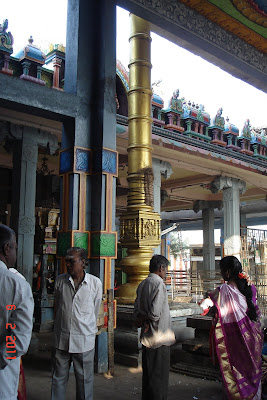
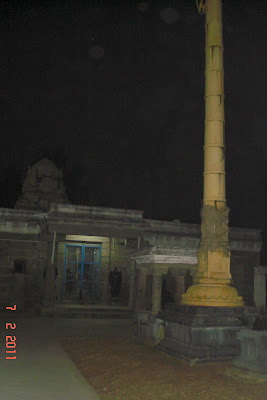
As we enter we see Dwajasthambam.
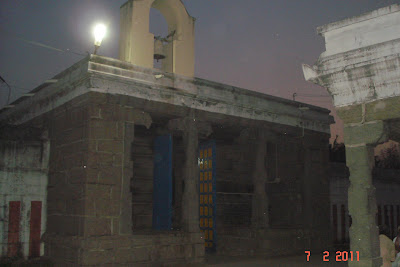
We see the entrance to, inner sanctum.
Main Deity is Swayambu Lingam known as Somanadhar and his consort known as Meenakshi Ammai.
As we go around the sanctum we see to south west corner a sanctum for Lord Subramanian known as Mutthukumara swamy. He is also known as Samhara Moorthy.
To north side of the prakaram there is a sanctum for Sri Kandha Swamy in standing posture with Abahya hastham along with peacock and Vel. To his either side, we see Valli and Devani.
There are other deities like Vinayakar, Dakshina Moorthy and Channdikeswarar.
Purana says Boodha Ganagal of Lord Siva worshiped Lord Murugan of this place.
As we go around the prakaram we see different form of Lord Murugan. Boodha Ganangal is seen in the outer prakaram.
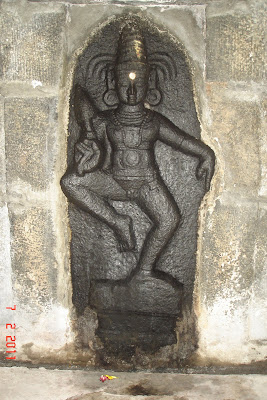
Nruthya Skandar.
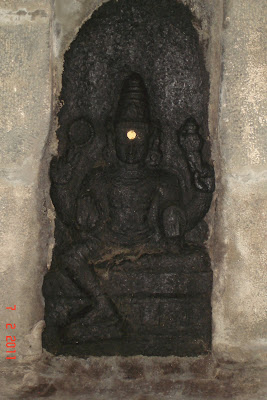
Brahma Sastha
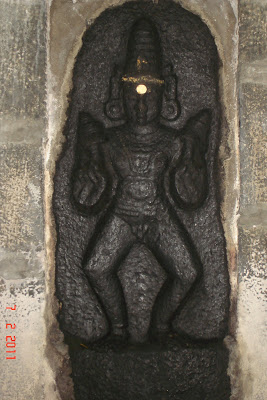
Bala Skandar
.
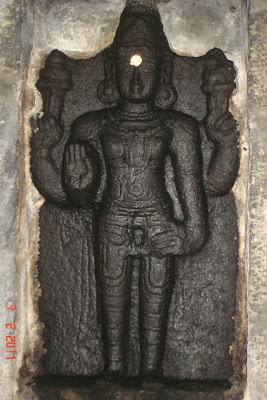
Sivagurunadhar.
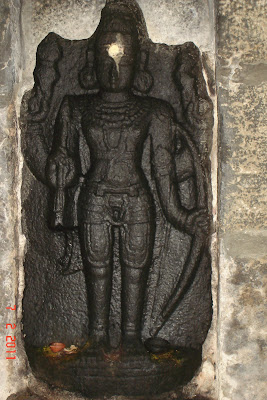
Pulinthar. (Hunter)
Arunagirinadhar sang Thirupugazh on Lord Murugan of this temple.
Vallakottai Murugan Temple. Kancheepuram District.
Posted by Shamala Krishnan in Asuras, devas, Dwajasthambam, Lord Subramanya, Sage Durvasa, Sage Naradha, Vallakottai Murugan.
The temple is in Kancheepuram district. The place is about 20kms west of Singaperumal koil, on Chennai – Vizhupuram National High way.
This is a very old temple of more than 1000years constructed by King Bageerathan, who was ruling Sankondpuram of Ilanji Kingdom.
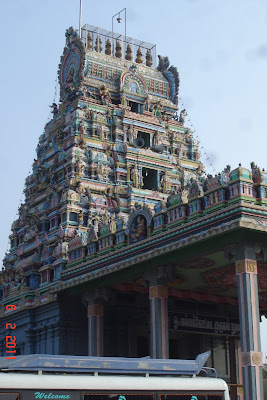
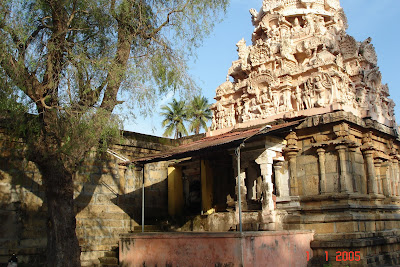
The temple has main Raja Gopuram of five tiers with a big mandapam to front.
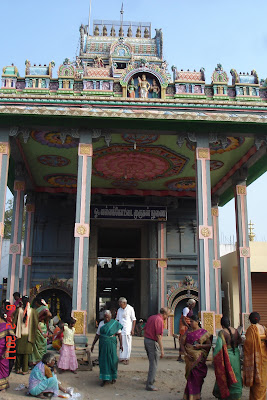
As we enter inside through the main door, we find a big Dwajasthambam
Main deity is Arulmigu Subramanya Swamy with Valli & Devasena. Arunagirinadhar sang Tirupugazh on Lord Murugan of this temple.
Here, the pushkarani of the temple is known as Vajra Teertham and Sthala Vruksham is Padiri tree.
Indara wanted to worship Lord Murugan. He approached his Guru Brahaspathyto guide him. Indra was asked to worship Lord Subramanya of Vallakottai by his Guru. Indra came to this place and he used his weapon Vajra to make a pond. He used the water from the pushkarani to worship Lord Subramanya. Hence the pushkarani is known as Indra Teertham and Vajra teertham.
There was a fort in which there was an Asura named Vallan. He was giving lot of trouble to Devas, who prayed to Lord Subramanya to help them. Lord Murugan killed the Asura. To fulfill the wish of Asura, Lord Murugan named the place as Vallan Kottai, which became Vallakottai over a period.
Sthala Purana says King Bageeratha was ruling Sankondapuram of Illanji Kingdom. Once when Sage Naradha visited his place he ignored him out of pride. Sage Naradha wanted to teach him a lesson. When he left the place he met asura named Koran who was celebrating his victory. Sage thought he can use Koran to teach a lesson for King Bageerathan. He addressed Koran and said your victory is nothing unless you defeat King Bageeratha. Koran waged war against Bageerathan King of Illangi. It was least expected, and Bageeradhan lost the battle and left the kingdom.
In the forest he met Sage Naradha, and begged for pardon. He asked him to guide, to get back his kingdom again. Sage Naradha asked him to meet Sage Durvasa and proceed according to his guidance. Sage Durvasa asked him to worship Lord Subramanya under the Padiri Tree on Fridays and get the blessing of Lord Murugan. King did as he was asked and he was blessed. King Bageeradha constructed a temple for Lord Subramanya in this place and the padiri tree is sthala Vruksham of the temple.
Arunagirinadhar was on visit to Murugan temples. After his visit to Thiru Porur he wanted to proceed to Thiruthani and rested for the night. In his dream Lord Subrananya said you have missed Vallakottai Murugan. Next day Arunagirinadhar visited Vallakotai Murugan and sang Thirupugazh on Lord Subramanya.
Thiru Chengkodu Temple, Erode.
Posted by Shamala Krishnan in Adi Kesava Perumal, Ardhanareeswarar, Arunagirinadhar, Devara Sthalam, Dwajasthambam, hymns, Thiru Chengottu Velavar, Thiru gyana sambandhar
Thiruchengkodu: Ardhanareeswarar Temple.
We traveled from Bhavani to Thiruchengkodu temple. The distance is about 25 kms. The hill is red in colour.
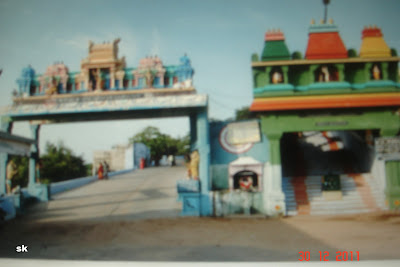
We find an arch at the entrance, with a road leading up for vehicles and steps, for pedestrians to climb. One has to climb 1200 steps to reach the temple door.
This is One of 275 Devara Sthalam of lord Siva.
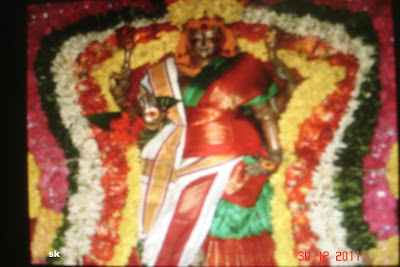
Ardhanareeswarar is one of 64 manifestation of Lord Siva, representing the unity of Sakthi and Siva. This is the one of the temple dedicated for Ardhanareeswarar as main deity. Normally Lord Siva is seen in Lingam form but here He is in human form.
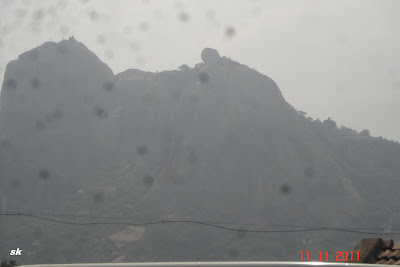
The Hill is in the Lingam form, and it looks like the union of Lord Siva and Sakthi as one.
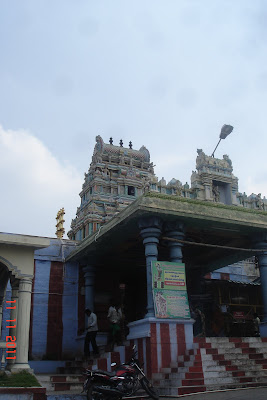
The main Raja gopuram is of five tiers.
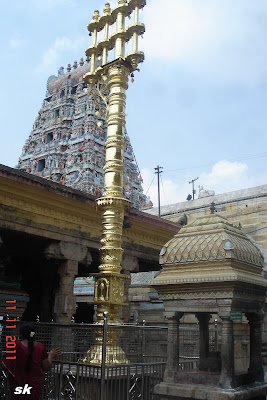
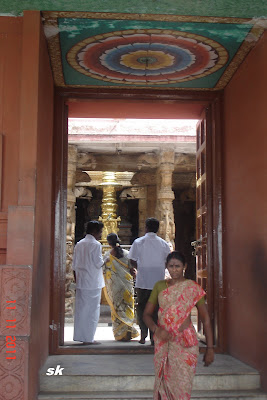
As we enter the main door we find Dwajasthambam. There is a mandapam with pillars having sculptures of various deities.
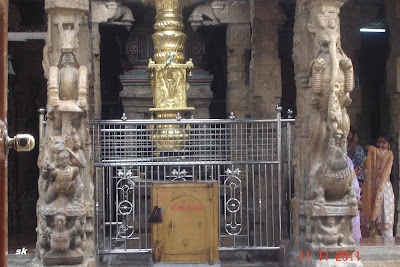
From here, we enter into to Murugan sannidhi, who is known as Thiru Chengkottu velavar. Chengkottu Velvar is as popular as Lord Ardhanareeswarar. Arunagirinadhar has contributed songs for Velavar of this temple in his Thirupugazh.
Main Deity is Swayambu Navabashana Ardhanareeswarar and Ambaal here, known as Bagampiriyaal. Ardhanareeswarar is a combination of Lord Siva and Parvathy. Right side of the deity is Lord Siva and the left side Ambaal. During Aarthi time, poojari will show near the leg where we can have darshan of four legs of Lord Siva and Ambaal Parvathy.
Teertham is known as Deva teertham which flows under the feet of Ardhanareeswarar.
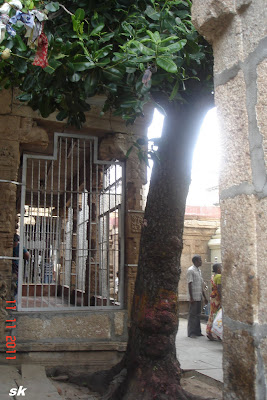
Sthala Vruksham: Iluppai Maram.
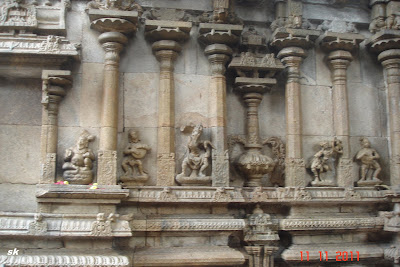
We find beautiful sculptures to the side walls of temple when we go around the temple.
Sthala Purana: Bringy Muni, was great devotee of Lord Siva and used to worship only Lord Siva. One day when Lord Siva and Parvathy Devi was together, Bringi Muni came to worship Siva; he took the form of BEE, and worshiped only Lord Siva and ignored Sakthi who was next to Lord Siva. Parvathy got agitated with Bringi, for his ignorance of not knowing power of Goddess Sakthi. She cursed him to loose his power for neglecting Her.
Lord Siva showed Bringui muni, his original form of Ardhanareeswarar, which is the form of Siva and Parvathy as one. There is a sculpture of Bringi Muni in the temple.
Importance: The Hill is in red colour. Once, “Adi seshan and Vayu Bhagawan” wanted to test who is powerful among the two. The condition was, “Adiseshan” should hold the mountain tight with his head and “Vayu” should release himself from the grip. When Adiseshn holded Vayu with his hood. Vayu blew fiercly and the mountain pieces fell at many places. The hill is known as Thiruchengkodu. The hill is in red colour, because of the blood that oozed when Adiseshan pressed Vayu bagwan, with his hood. The hill is also known as Nagagiri and Vayu malai.
Inside the temple premises we see a small sanctum for Adiseshan
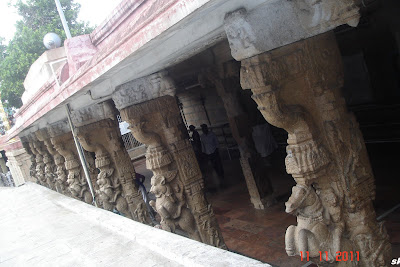
We see these pillars, as we go around.
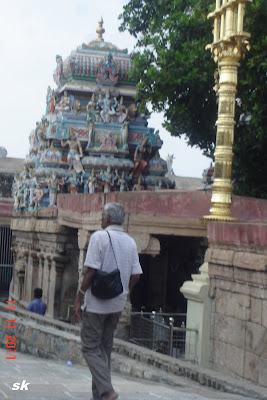
As we go around the temple there is a separate shrine of Adi Kesava Perumal with dwajasthambam in front.
We see other deities like Vinayakar, Viswanadhar and Visalakshi, Natarajar and Sivakami ammai, Siddhi Vinayakar, Adi seshan, Sooryan, Bairavar, and Navagraha.
Thiru Gyana Sambandhar sang Hymns on Lord Siva.
We traveled from Bhavani to Thiruchengkodu temple. The distance is about 25 kms. The hill is red in colour.
We find an arch at the entrance, with a road leading up for vehicles and steps, for pedestrians to climb. One has to climb 1200 steps to reach the temple door.
This is One of 275 Devara Sthalam of lord Siva.
Ardhanareeswarar is one of 64 manifestation of Lord Siva, representing the unity of Sakthi and Siva. This is the one of the temple dedicated for Ardhanareeswarar as main deity. Normally Lord Siva is seen in Lingam form but here He is in human form.
The Hill is in the Lingam form, and it looks like the union of Lord Siva and Sakthi as one.
The main Raja gopuram is of five tiers.
As we enter the main door we find Dwajasthambam. There is a mandapam with pillars having sculptures of various deities.
From here, we enter into to Murugan sannidhi, who is known as Thiru Chengkottu velavar. Chengkottu Velvar is as popular as Lord Ardhanareeswarar. Arunagirinadhar has contributed songs for Velavar of this temple in his Thirupugazh.
Main Deity is Swayambu Navabashana Ardhanareeswarar and Ambaal here, known as Bagampiriyaal. Ardhanareeswarar is a combination of Lord Siva and Parvathy. Right side of the deity is Lord Siva and the left side Ambaal. During Aarthi time, poojari will show near the leg where we can have darshan of four legs of Lord Siva and Ambaal Parvathy.
Teertham is known as Deva teertham which flows under the feet of Ardhanareeswarar.
Sthala Vruksham: Iluppai Maram.
We find beautiful sculptures to the side walls of temple when we go around the temple.
Sthala Purana: Bringy Muni, was great devotee of Lord Siva and used to worship only Lord Siva. One day when Lord Siva and Parvathy Devi was together, Bringi Muni came to worship Siva; he took the form of BEE, and worshiped only Lord Siva and ignored Sakthi who was next to Lord Siva. Parvathy got agitated with Bringi, for his ignorance of not knowing power of Goddess Sakthi. She cursed him to loose his power for neglecting Her.
Lord Siva showed Bringui muni, his original form of Ardhanareeswarar, which is the form of Siva and Parvathy as one. There is a sculpture of Bringi Muni in the temple.
Importance: The Hill is in red colour. Once, “Adi seshan and Vayu Bhagawan” wanted to test who is powerful among the two. The condition was, “Adiseshan” should hold the mountain tight with his head and “Vayu” should release himself from the grip. When Adiseshn holded Vayu with his hood. Vayu blew fiercly and the mountain pieces fell at many places. The hill is known as Thiruchengkodu. The hill is in red colour, because of the blood that oozed when Adiseshan pressed Vayu bagwan, with his hood. The hill is also known as Nagagiri and Vayu malai.
Inside the temple premises we see a small sanctum for Adiseshan
We see these pillars, as we go around.
As we go around the temple there is a separate shrine of Adi Kesava Perumal with dwajasthambam in front.
We see other deities like Vinayakar, Viswanadhar and Visalakshi, Natarajar and Sivakami ammai, Siddhi Vinayakar, Adi seshan, Sooryan, Bairavar, and Navagraha.
Thiru Gyana Sambandhar sang Hymns on Lord Siva.
Alagai / Tanjapureeswarar temple, Tanjavore.
Posted by Shamala Krishnan in Dakshina moorthy, Dwajasthambam, Natarajar, subramanayar, Vaippu Sthalam., vinayakar
- Alagai / Tanjaipureeswarar Temple:
The temple is one of the Devara Vaippu Sthalam.
The temple is located 3 kms from Tanjavore Town. The place is known as Alagapuri on the banks of River Vennaru.
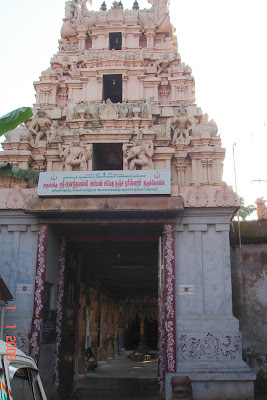
From Alagai / Tanjapureeswarar temple, Tanjvoore.
The temple gopuram is of three storeys. As we enter inside we see Dwajasthambam.
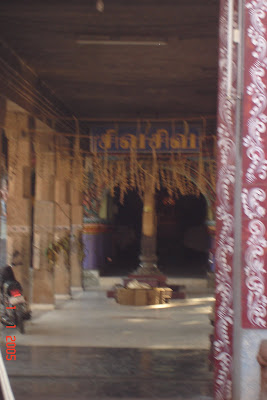
From Alagai / Tanjapureeswarar temple, Tanjvoore.
Main deity here is Swayambu Lingam known as Arulmigu Tanjapureeswarar and his consort known as Anandha valli Amman.
Sthala vruksham of the temple is Vilvam. Here the teertham is Veearu and Sivagangai Teertham.
From Alagai / Tanjapureeswarar temple, Tanjvoore.
Other deities seen in the temple are, Vinayakar, Subramanyar, Natarajar, Dakshina Moorthy, Kubera and Thirunavakkuarasar.
Purana says Kubera was born here, as a vaisaya and worshiped Sivalinga of this place. Hence the place is known as Alagai.
There are number of stone inscriptions seen in the temple.
Befriend on Facebook
Archives
-
▼
2014
(15)
-
▼
Feb
(7)
- Sri Thuoovai Nadhar Temple and Sri Thuoovai Nadha...
- Thiru Neiythanam / Thillai sthanam: Neyyadiappar ...
- Keezha Pazhuvoore: Arulmigu Vadamoola Nadhar Temp...
- Thiru Mazhapadi, Sri Vaidhyanadhar Temple, Ar...
- Thiruvaalam pozhil, Athmanaadeswarar Temple, Tan...
- Thiru kattupalli: Agneswarar temple. Tanjavoore.
- Thiru Vedikudi, Vedapureeswarar Temple. Tanjore
-
▼
Feb
(7)
Contributors
My Other blogs
About this Blog
My travelogue is about various Ancient Indian temples across the country with extensive focus on certain unique facts about these religious destinations.
I have documented my thoughts and experiences from my travels and hope to showcase our rich cultural and religious heritage.
Copyright
Ancient Temples of India by http://ancientindiantemple.blogspot.com/ is licensed under a Creative Commons Attribution-Noncommercial-No Derivative Works 2.5 India License.
Categories
- 63 Nayanmars
- Aananda Thandavam
- Adi Kesava Bakthavatchalar
- Adi Kesava Perumal
- Adi Sakthi
- Adi sankarar
- Adigara Nandi
- Adimoolar
- Adisheshan
- Agastheeswarar
- Agasthiyar
- Agasthya muni
- Agasthyar
- Agazhi
- Agni
- Agni Bagawan
- Agni bhagawan
- Agni teertham
- Agora moorthy
- Ahobalam
- Akilandeswari
- Akora Veerabadharar
- Akshya Patra
- Amla
- Amman temple
- Ammayappar
- Amrutha kalasam
- Anandha Thandavam
- Ancient Temple
- Andal
- Anjaneyar
- Anjaneyar temple
- Annadhanam.
- Annakooda Utsavam
- Annamaliyar
- Annpoorani
- Ant hill
- Antarvedi
- Appar
- Aranyam
- Aravara Vinayakar
- Arcot temples
- Ardhanareeswarar
- Arjuna
- Aru padai veedu
- Arumugan
- Arunagirinadhar
- Arunagitinadhar
- Arungirinadhar
- Ashram.
- Ashtabuja Kali
- Ashtalakshmi
- Asura Guru
- Asuras
- Aswamedha yaga
- Athithi
- Athri
- Athri muni
- Atta veeratta sthalam
- Attaveeratta Sthalam
- Atthi maram
- Aunagirinadhar
- Avudayar
- Avvaiyar
- Ayodhya
- Azhwar
- Azwar
- Bada Imambara
- Badra Rishi
- Bairavar
- Bairavar and Navagraham
- Bairavar.
- Baktha Aanjaneyar
- Bala Ganapathy
- Bala Murugan
- Balalyam.
- Balipeetam.
- Baradwaj Ashram
- Baradwaja Maharishi
- Baradwajar
- Bava Narayanar
- Beema Lingam
- Bheema
- Bheemavaram
- Bhoodevi
- Bindu Madav
- birla mandir
- Birth place
- Bodhi Vruksham
- Boo kailasam
- Bow
- Brahama
- brahamapureeswarar
- Brahma
- Brahma Sastha
- Brahmahathi Dosha
- Brahmaotsawam
- Brass bell
- Brigu Muni
- Brungi muni
- buddha
- Cauvery
- Cave
- Cave temple
- celing
- chakkra teertham
- chakkram
- Chakkratazhwar
- chalukya
- Chamundeeswari
- Chandeekeswarar
- Chandeeswarar
- Chandekesar
- Chandikeswarar
- Chandra Sekarar
- Chandran
- Chariot
- Chattai Nadhar
- Chatura Thandavam
- Chera
- Chidambaram
- chikankari
- Chinna masta
- Chinna tirupathy
- Chitraguptar
- Chittar
- Chokkanadhar
- Chola and Pandya Kings
- Cholan
- Chriot
- Cliff
- Cochenga Cholan
- Cochengat Cholan
- conflunce
- Counch
- cow Hoof
- Cuddlore.
- Dakshan
- Dakshina moorthy
- Dakshina Murthy
- Danvantri
- dara pathra
- Darbar
- Dasaradha
- Dattatreyar
- deeksha
- Desikar
- Devadhana perumal
- Devaki
- Devani
- Devara Sthalam
- Devara Sthalams
- devas
- Devera Sthalam
- dharma chakkra
- Dharmasthala
- Divya Desam
- divya Prabandham
- Duragai
- Durgai
- Durvasa maharishi
- Durvasa Muni
- Dwajasthambam
- dwaraka thiruamala
- elephant
- Erikuppam
- Errukku
- Fort
- Gaja Lakshmi
- Gajalakshmi
- gajaprushta vimanam
- Ganapathy
- Ganapathy.
- Ganesha
- Ganeshpuri
- Ganga water
- Gangai
- Garuda
- Garuda Teertham
- Garudan
- gayatri
- Godavari ghat
- godavari west
- Goddess
- Goddess Kamakshi
- Goddess Saraswathy
- Govardhana giri
- gowdi matha
- Gowthamar
- Guru sthalam
- Gurukulam
- Gyana
- Gyana Sakthy
- Hanumakonda
- Hanuman
- Hayagreevar
- Hill temple
- hillock
- Honey
- Hot springs
- hunter
- hymns
- images
- Indra
- Indran
- inscriptions
- Iravadeeswarar
- Iravadham
- Iyanar
- iyappa
- Jack Tree
- Jagadatri
- Jagan mohini
- Jaggayyapet
- Jain mandir
- Jalakandeswarar
- Jamadagni Muni
- Japanese
- Japesar
- jeeva Samadhi
- Jeeyer Swamigal
- Jogulamaba
- Jurahareswarar
- jyothir linga
- Kailasa Nadhar
- Kala bairavar
- Kala chakkra
- Kala Gyanam
- Kalakaleswarar
- Kalaram
- Kalasamhara Moorthy
- Kaleeswaram
- Kali
- Kali temple
- Kaliyugam.
- Kallala Vruksham
- Kalyana Kamakshi
- Kalyana sundarar
- Kamadenu
- Kamakoore
- Kamakshi
- Kamandala River.
- Kamandaleswaar
- Kamsa
- Kamya Vanam
- Kannappar
- Kanni Murugan
- Karpaga Vinayakar
- Kasi
- Kasi Viswanadhar
- Kasyapa Muni
- Kavcham
- Kdamba vanam
- Kdmbavana Dakshina Murthy. and saraswathy.
- Kesava perumal
- Kesvaperumal
- Khammam.
- King
- King Vikramaditya
- kishna River
- kodhanda ramar
- Kondrai
- Kondrai Tree
- kondrai.
- Korai
- Kradha Moorthy
- Krishna.
- Krishnaveni
- krodha moorthy
- Krupanandavarior.
- Kshetram
- Kulothunga Cholan
- Kundika.
- Kurnool.
- Kusha
- Lakshmana
- Lakshmi
- Lakshmi ganapathy
- Lakshmi Narashimar
- Lakshmi Narasimhar
- Lakshmi Narayanar
- Lava
- legend
- Lingam
- Lingothbavar
- Lingothbawar
- Lord Balaji
- Lord Brahma
- Lord Ekambareswarar
- Lord krishna
- Lord Murugan with Valli and Devanai
- Lord Narayanar
- Lord Siva
- Lord Subramanya
- Lord Vinayakar
- Lord Vishnu
- Lord Vishnu.
- Lotus
- Lotus.
- Lucknow
- Maadak Koil
- Maadakoil
- Machya avathram
- Madak Koil
- Madakoil
- Madhava perumal
- Madhva Siddantham
- Madhya pradesh
- Magizha Maram
- Maha Bali
- Maha Ganapathy
- Maha Kali
- Maha Lakshmi pureeswarar
- Maha Meru
- Mahadevar
- Mahalakshmi
- Mahalakshmi Temple
- Maharashtra.
- Maharishi
- Mailaduthurai
- Makaradwaj
- Mandava Narayanar
- Maragadha Lingam
- Mariamman
- Marimman
- Markandeyar
- Marriamman temple
- Marriamman temple.
- mavulamma
- Meda Dakshina Moorthy
- Meenakshi
- Mohini
- Moksha
- Moon
- Mooshikam
- mosque
- Mukthi
- mukthy
- Mullai
- Murugan
- museum
- Naagar
- Naalwar
- Nadu Naadu
- Nadu Naadu Devara Sthalam.
- Nadu Nadu
- Nadu Nadu Devara Sthalam
- Nadu Nadu Devara Sthalams
- Nadu Nadu temple
- Nadu Nadu Temples
- Nagamangala
- Nagar
- Nagar.
- Nagaraja
- Nalvar
- Nalwar
- Nambi Andaan Nambi
- Nandhi
- Nandi
- Nannilam
- Narashima Kshetram
- Narashima swamy. lakshmi
- Narashimar
- Narashimar.
- Narayana teerthar
- Nardhana Ganapathy
- Nardhana Vinayakar
- Natarajar
- Naukkarasar
- Nava Brahma
- Navagraha
- Navagraha Sthalam
- Navagraha temple.
- Navagraham
- Navagraham Chandikeswarar
- Navakkuarasar
- Navgraha
- Navukkarasar
- Navukkuarasar. Atta veeratta Sthalam
- Nayanar
- Nayanar. agni Bhagawan. urchava idols
- Nayanmarar
- Nayanmars
- Nectar
- Neymisaranyam
- Ngr
- Nimishambal
- Padadarshan.
- padala Nandi
- Padavedu
- Padikasu vinayakar
- Padmavathy
- paduka
- palace.
- Palm print
- Pancha Boodha Lingams
- Pancha boodha Sthalam
- Pancha Krishna Ksetram
- Pancha krishna kshetram
- Pancha Lingam
- Pancha Lingam Nalwar
- Pancha madhava kshetram
- Pancha Narashima Kshetram
- Pancha Puliur
- pancharama kshetram
- Pancharanya kshetram
- Pandiyan
- Pandvas.
- Pandyan
- Parasakthy
- Parasurama
- Parasuramar
- Paravai Nachiar
- Paravai Nachiyar
- Paravayul maandali
- Parihara Sthalam
- Parrot
- Parvathy
- Pasupathasthram
- Patanjali muni
- Pathangali Muni
- peacock dance
- Peddamma
- penance.
- Perumaal
- Perumal
- Pichadanar
- Plantain
- Polla Pillayaar
- Pongu Sani
- Pradosha Nandi
- Pradosham
- Prahaladha
- Prahladha
- Prakaram
- Pranava Mantra
- Prithivi Kshetram
- Pundarikavalli
- Punga
- Punnai
- purana
- purana.
- pushkaram
- Pushkarani
- Pushkarani.
- Pushkrani
- Pushkrani.
- Putharakamesti yagam
- Raja Ganapathy
- Raja Gopuram
- Rajayalakshmi
- ram mandir
- Rama Lingam
- Rama.
- Ramana Maharishi
- Ramar
- Ramayan
- Rameswarar
- Ranganadhar
- Rath yatra
- Rathi Manmadhan
- Rathnagiri
- Renuka matha
- Renukambal
- Rishabaroodar
- Rishi
- River
- River Arasalaru
- River Cauveri
- River Cauveri.
- River Cauvery
- River Cauvery.
- River Godavari.
- River Gomathy
- River Gowthami
- River kedila
- River Kollidam
- River Kumaramangala.
- River Netravathy
- River Penna
- Romesa Muni
- Rudraksha
- Rukmani and sathyabama
- Rukmani Kalyanam
- Sadasivan
- Sage Durvasa
- Sage Naradha
- Saint
- sakthi peetam
- sakthi peetam.
- sakthi petam
- Sakthi temples
- Sakthi Vel
- Sakthy
- Salem temples
- Salem temples.
- Saligrahma
- sambandhar
- Sambandhar and Arunagirinadhar
- sambandhar.
- Sambndhar.
- Saneeswarar
- Sangamam
- Sangamam.
- Sangamam. Siva temple
- Sangili Nachiar
- Sangili Nachiyar
- Sani Bagawan Chandekeswarar and Natarajar
- Sani Bhagawan
- Sani Bhagawan.
- Sani Dosha
- Sankar matt
- sanku
- santha roopa Kamakshi
- Santhana Gopalan
- Saptha Kanniyar
- Saptha prakaram
- Saptha rishi
- Saptha Sthana Sthalam
- Saptha Sthana Sthalams
- Saptha Vidanga Sthalam
- Sapthamadhar
- Sarabeswarar
- Saraswathi
- Saravana Poigai
- sarawathi temple
- Sarnath
- saryu
- sathyanarayana swamy
- Sculpture
- sculptures
- sekizhar
- Selva Ganapathy
- Sevi Saaitha Vinayakar
- Shadaranyam
- shadow work
- Shanmugar
- Shimavahini
- Shiva
- Shiva Ganas
- Siddeswarar
- Siddhar
- Siddhi Vinayakar
- Sikara
- Singaravelan
- sita
- Sita Samhitha Sthal
- Sitamari
- Siva and Parvathi.
- Siva Devara sthalam
- Siva Ganas
- Siva Gyanam
- Siva Lingam
- Siva Lingam Yagnam
- Siva Lokanadhar
- Siva Rahyasam
- Siva temple
- Siva Thandavam
- siva.
- sivachariyar
- Soma Skandar
- somasilla
- Somaskandar
- Someswarar
- someswarar.
- someswarar. Bheemeswarar
- Soorya
- Soorya Bagawan
- Soorya Lingam
- Soorya Narayanar
- Soorya teertham
- sooryan
- Sparrow
- Sri BrahmamaGaru
- Sri Chakkra
- Sri Chandrasekarar
- Sri Narashimar
- Sri rama
- Sri Rama.
- Sri Ramanujar
- Sri Ramar
- Sri Uma Maheswarar
- Sri Venkateswara
- Sri Venkateswarar
- Sridevi
- Sriman Narayanar
- Sthala Puranam
- sthala Vruksham
- Sthhala Vruksham
- sthupa
- Stone inscription
- Stone inscriptions
- Stone inscriptions Thiru Navukkarasar
- Suasambikai
- subramanayar
- Subramanya swamy
- Subramanyar
- Sukabrahma Rishi
- Sukar
- Sukran
- Sun
- Sundarar
- sundarar.
- sundrar
- Swamynarayan Mandir
- swayambu
- swayambu Lingam
- Swayambu Lingam.
- Swayambu Lingam. sakthi peetam
- Swayambu Lingam. subramanya swamy
- swayambu Lingam.Sambandhar
- Swayamvektha Kshetram
- swaymbu lingam.
- Teerham
- teertham
- temple painting
- Temples around Kancheepuram.
- Temples of Kancheepuram.
- Temples of kumbakonam
- Temples of Kumbakonam.
- Thadalan
- thapas Kamakshi
- Thayar
- Thillai
- Thinai
- Thiru Gyana sambandhar
- Thiru Chengottu Velavar
- thiru Dharamapura adeenam
- Thiru gyana sambandhar
- Thiru Gyana Sambandhar.
- Thiru mandiram
- Thiru Navakkarasar
- Thiru Navakkuarasar
- Thiru Navakkuarsar
- Thiru Navukkarasar
- Thiru Navukkarasar and Sundarar
- Thiru Navukkuarasar
- Thiru Thandakam
- Thiru Vedaimarudhur.
- Thirumaal
- Thirumangai Azwar
- Thirumoola Nadhar
- Thirumoolar
- Thirunavukkuarasar
- thirupugazh
- Thirupugazh.
- Thiruvavaduthurai
- Thiruvavaduthuri Adeenam
- thoniappar
- Thyar
- Tirumala
- Tirupugazh
- Tortoise
- Trichy temples
- Tridev
- Tulasi plant
- Ugra kali
- Ugra Narashimar
- uma
- uman
- Upadesam abd Thiru Gyana Sambandhar
- uppanaru
- Urchava idols
- Vaippu Sthalam.
- vajreswari
- Vakarakali
- Valampuri Vinayakar
- Valiyan
- Vallakottai Murugan.
- Valli
- valmiki
- Vamadevam
- Vamadevar
- Vamana
- Vanni Vanam
- Vanni Vruksham
- Varadaraja Perumal
- Varadarajar
- Varaha
- Varaha perumal
- varahar
- Vashister. Rishyasringa muni
- Vasishta maharishi
- Vasishtar
- Vasishter
- vasuki
- Vatapi
- Vaygyapadhar
- veda Nayaki
- Vedas
- Veena Vidyambica
- Veera Aanjaneyar
- Veeratta Sthalam
- Vel
- Velayudham
- Vellore
- Veni Madhawar
- Venkatesa Perumaal
- Venkateswara
- Venu gopala swamy
- veratta sthalam
- Verrateswarar
- Vidhyadharan
- Vilva
- Vilva vruksham
- Vilvam
- Vilwam
- vinayakar
- Vinayakar.
- Vinaykar
- vindhyavasini
- Vippu sthalam
- viraja River
- Visalakshi
- Vishnu
- Vishnu Durgai and Chandeekeswarar
- vishnu temples
- vishnu temples. Divya Desam.
- vishnu temples.Navagraha sthalams
- vishnu temples.Temples of coimbatore
- vishnu temples.Temples of coimbatore.
- vishnu temples.Temples of kumbakonam
- Vishvaksenar
- Viswakarma
- Viswanadhar
- Vizhupuram
- Vyagyapadhar
- Vyagyapdhar brahma
- Vyasa
- Vyasar
- Vyasar basar AP
- Vyasarajar
- Vyaseswarar
- Vysar
- Warangal Ap
- west godavari
- Yaga
- Yaga.
- yagam
- yagasala
- Yagna
- yama
- Yama.
- Yantram
- Yazh
- Ygnasalai
- Yoga dhyanam.
- yoga ramar
- Yugam
- Yugam.